

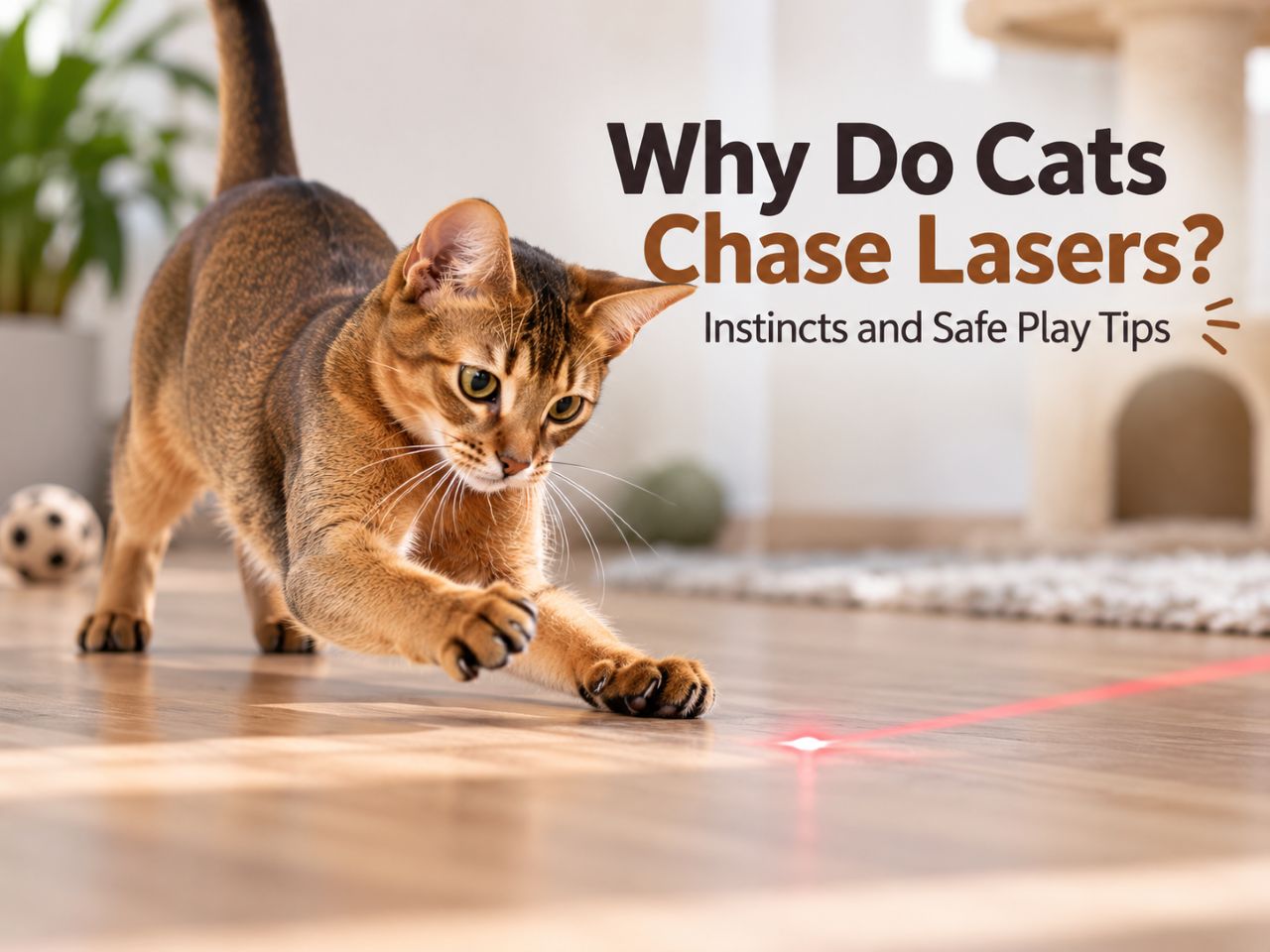
Cats chase lasers because the moving dot triggers their natural hunting instincts. A small target that darts across the floor, pauses, and suddenly changes direction gives a cat something to stalk and pursue. Your cat can respond to those movements even after a full meal. The tricky part comes when they pounce. Their paws land on the target, but there is nothing to hold. Some cats lose interest and walk away. Others keep searching for the light after it disappears. That difference matters. A good play session gives your cat an engaging activity they can comfortably leave behind when it ends.
Why a Tiny Moving Dot Gets Such a Big Reaction
A moment ago, your cat was resting beside the couch. Now their body is low, their eyes are fixed on the floor, and they are waiting for the right moment to jump. The laser has provided a moving target for a familiar sequence: watch, stalk, chase, and pounce.
Movement Triggers the Chase
Cats are predators, and movement helps draw their attention to potential prey. A laser dot can supply some of those visual cues without having the shape, smell, or texture of a real animal. Its direction changes keep giving your cat something new to track. A dot that slips around a chair leg may prompt them to reposition before approaching again. That does not mean your cat definitely believes the light is a mouse. We cannot know exactly what an individual cat thinks it is. We can observe that its movement encourages hunting-related behavior.
A Full Food Bowl Does Not Remove Hunting Instincts
Hunting behavior is not driven by hunger alone. Well-fed cats may still stalk insects, chase toys, and watch birds through a window. Food and play meet different needs. Eating supplies nutrients; playtime gives your cat opportunities to move, explore, and practice behaviors that come naturally. A cat chasing a laser is not necessarily asking for another meal or being “naughty.” The moving target may simply be appealing.
The Color Is Not the Main Attraction
People often call it the “red dot,” but there is no need to assume red is what makes the game exciting. Cats see colors differently from people, and their vision is well suited to detecting movement in dim conditions. A moving point of light can catch their attention without appearing exactly as it does to you. The stronger explanation for the chase is the target’s movement, rather than a special preference for red.
Why Catching Matters as Much as Chasing
A toy mouse stops when your cat pins it down. A soft toy can be grabbed, bitten, and kicked. Those actions provide physical feedback. A laser offers no such response. The cat may land directly on the dot, lift a paw, and find the target still there—or suddenly somewhere else. The missing catch can make laser play frustrating for some cats. It is one reason an energetic chase should not automatically be treated as evidence that the whole experience is satisfying. Watch what happens when the game finishes. Does your cat move on to another activity? Or do they repeatedly return to the same patch of floor, searching for something that is no longer there? A brief look around does not establish a behavior problem. Persistent searching that becomes difficult to interrupt deserves closer attention.
Are Laser Pointers Bad for Cats?
Laser pointers have potential risks, but a single chase does not mean your cat has been harmed. The main concerns are eye exposure, physical injury during the chase, and difficulty disengaging from an unreachable target. Repetitive light or shadow chasing is another reason to be cautious, although laser play alone does not establish the cause of that behavior. Your cat’s response matters more than how entertaining the chase looks. A cat who becomes increasingly fixated on reflections needs a different activity, even if they eagerly run toward the laser whenever it appears. A physical toy gives your cat a target they can catch and removes the laser beam from the game.
How to Make Laser Play Safer and More Satisfying
For households that already use a laser, a few changes can help address its limitations.
Prepare the Floor Before Starting
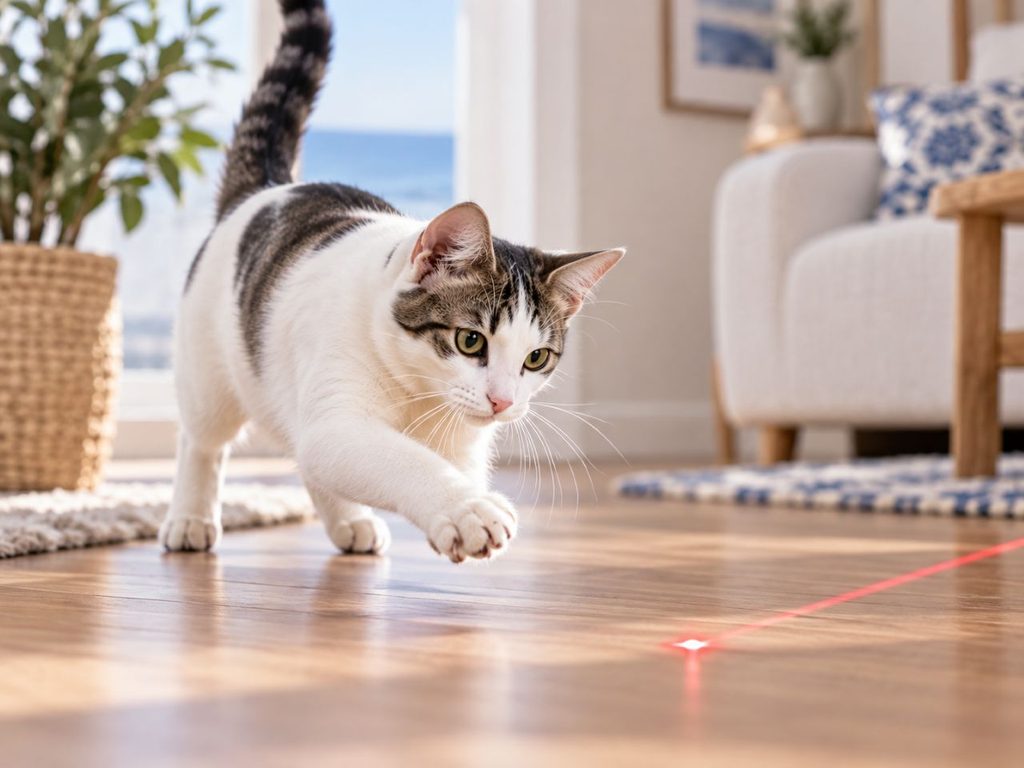
Choose an uncluttered space with secure footing. Move breakable objects and anything your cat might collide with. Keep the light on the floor. Avoid directing it up walls, toward stairs, or onto narrow furniture where an excited leap could end in an awkward landing. Match the movement to your cat’s abilities. A slower target close by may be more appropriate for a less active cat than a rapid chase across the room.
Include Time to Watch and Stalk
Do not make every moment a sprint. Pause the target and let your cat observe, approach, and decide whether to pounce. Start with a brief session and allow breaks. There is no universal number of minutes that suits every cat, and exhaustion should never be the goal. Let your cat walk away. Following them with the dot to restart the chase removes their opportunity to finish.
Switch to Something Your Cat Can Grab
Have a physical toy ready before turning on the laser. During the session, stop the light and introduce that toy so your cat can pursue and capture it. For example, move a toy mouse a short distance along the floor, pause, and let your cat pin it down. Give them a chance to hold it instead of immediately pulling it away. Ending with a tangible reward, such as a small portion of their usual food, is another option. A reward does not guarantee that laser play will suit your cat, though. Continued searching or fixation is still a reason to change the activity.
Keep the Beam Away From Eyes
Never shine a laser into a person’s or animal’s eyes. Avoid mirrors, polished metal, and other surfaces that could reflect the beam. Do not assume a device is harmless because it is labeled as a pet toy. Avoid high-powered or unlabeled lasers, and keep the pointer under adult control. Supervision also lets you stop immediately when the chase becomes unsafe or your cat seems unsettled.
When to Stop Playing and Contact a Vet
Ordinary play can include intense concentration. What deserves attention is a pattern that continues outside the game or interferes with everyday life. Put the laser away when your cat repeatedly:
- Searches floors and walls after the light has disappeared.
- Pursues reflections or shadows during unrelated activities.
- Struggles to shift attention to food, rest, or other play.
- Becomes increasingly agitated during or after the chase.
Do not punish the behavior or keep bringing the light back to distract your cat. Offer a physical activity and observe whether the pattern continues. Schedule a veterinary appointment when the behavior persists, becomes difficult to interrupt, or disrupts normal routines. Record a short video and note when it happens. Your veterinarian can consider health, household changes, stress, and daily stimulation rather than assuming the laser explains everything. Seek immediate veterinary care for difficulty breathing, including labored breathing or ongoing open-mouth breathing. Stop play immediately and do not dismiss these signs as a normal result of exercise.
Why Some Cats Ignore Lasers
Not every cat finds moving light interesting. Some prefer the sound of a rustling toy, the texture of something they can grab, or a slower target they can approach from cover. Ignoring a laser by itself does not mean a cat is lazy, has poor hunting instincts, or cannot see properly. A laser is not a reliable home vision test. Try different movements and textures without forcing participation. A toy dragged briefly behind a cardboard box may invite interest where an exposed target does not. In multi-cat homes, offer separate play opportunities. One cat may stay back when another consistently takes over the game. Individual sessions give each cat room to participate at their own pace.
Final Thoughts
Cats chase lasers because moving light taps into their hunting instincts, but chasing is only part of the experience. Finish with a physical toy your cat can grab, allow breaks, and let them walk away when they are done.
Watch what happens afterward. A cat who keeps searching for the dot or becomes fixated on reflections may need a different kind of play. Put the laser away, offer catchable toys, and talk with your veterinarian if the behavior continues.
Frequently Asked Questions
1. Do cats know the laser comes from your hand?
Some cats may learn that picking up the pointer predicts play. That association does not tell us exactly how they understand the light or whether they recognize why it cannot be caught.
2. Can laser pointers cause compulsive behavior?
Laser play has been associated with repetitive behaviors, but that does not prove it causes a compulsive disorder. Persistent light chasing needs veterinary assessment, especially when it interferes with normal activities.
3. How long should a cat play with a laser?
Keep sessions brief, allow pauses, and follow your cat’s response. Stop before fatigue or agitation, and finish earlier when your cat loses interest. There is no need to reach a set time.
4. Is a treat enough to make laser play satisfying?
A treat provides a tangible reward, but it cannot guarantee that your cat will settle afterward. Some cats do better with a physical toy they can capture. Others may need laser play removed entirely.
5. Give Your Cat a Clear Finish
At Catsoria, we encourage paying attention to the quieter moments after play as well as the exciting chase. Have a catchable toy ready, allow pauses, and let your cat finish when they choose. Afterward, notice whether they return comfortably to their usual activities. Repeated searching or growing fixation is your cue to put the laser away and address the change.