

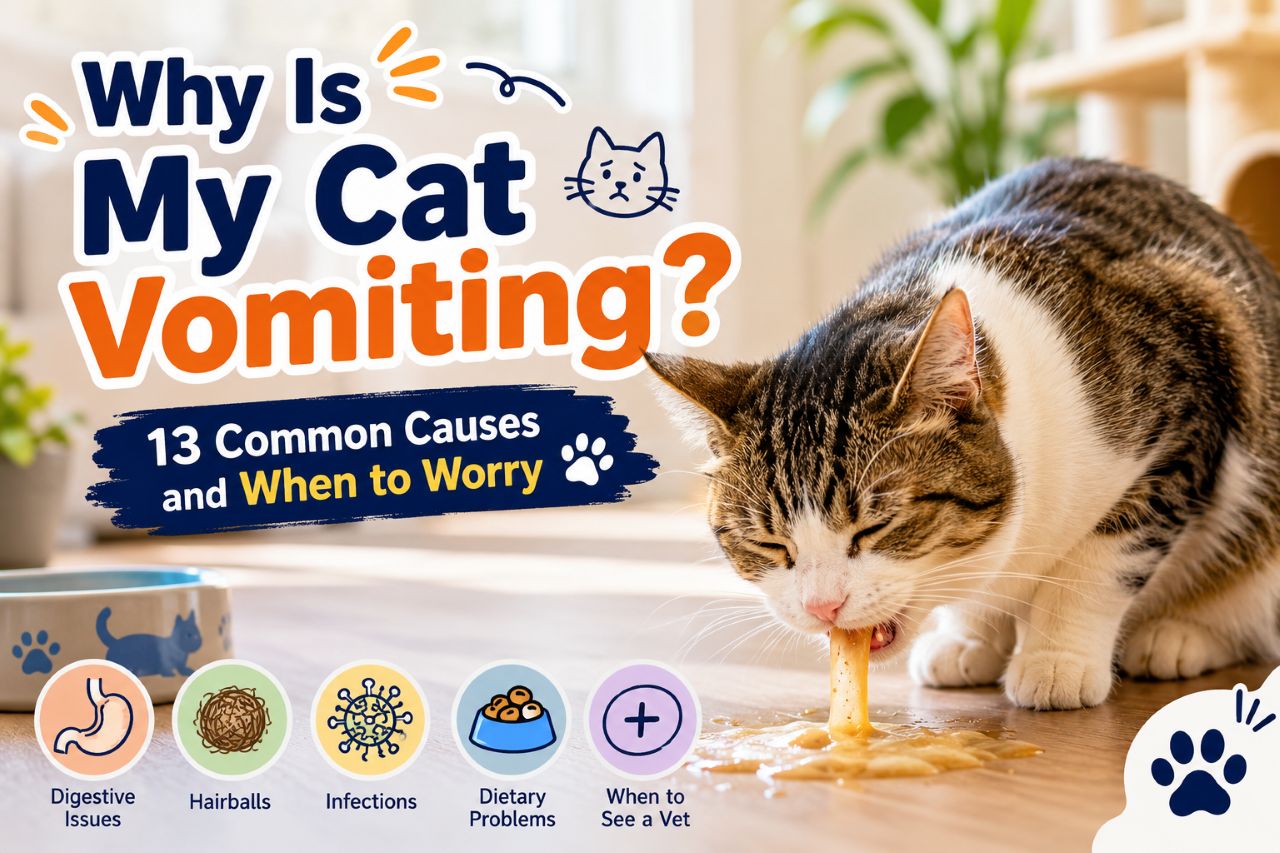
Your cat may be vomiting because of something simple, like eating too fast, coughing up a hairball, or reacting to a sudden food change. But cat vomiting can also point to parasites, food intolerance, toxins, kidney disease, diabetes, inflammatory bowel disease, a swallowed object, or another medical problem.
A single episode is not always an emergency. Still, vomiting should not be treated as “just a cat thing.” Cornell Feline Health Center notes that cats who vomit more than once a week, or vomit along with weakness, appetite loss, blood, thirst changes, urination changes, or diarrhea, should be checked by a veterinarian promptly.
So, if you are standing over the carpet asking, “why is my cat vomiting?”, this guide will help you sort the mild messes from the red-flag moments.
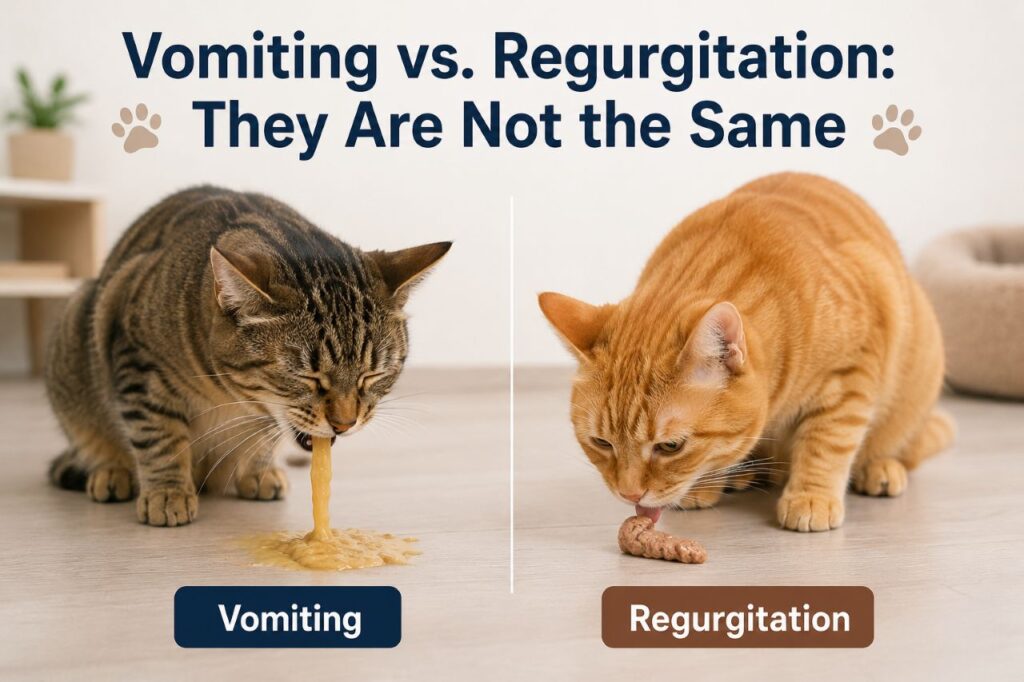
Vomiting vs. Regurgitation: They Are Not the Same
Before you decide what to do, try to figure out whether your cat is truly vomiting or regurgitating.
- Vomiting is active. Your cat may crouch, drool, heave, gag, or make repeated belly contractions before bringing up food, liquid, bile, foam, or hair.
- Regurgitation is more passive. Food may come up quickly with little effort, often in a tube-like shape. It may look mostly undigested because it has not spent much time in the stomach.
Catsoria explains that vomiting, regurgitation, and coughing can look similar to cat owners, but they can have different causes. Taking a short video for your vet can help them understand what is really happening.
That little video may be gross. It may also be useful. Welcome to pet parent detective work.
When Is Cat Vomiting an Emergency?
Call your veterinarian or an emergency animal hospital right away if your cat has any of these signs:
- Vomiting more than two or three times in a row
- Cat vomiting and not eating
- Vomiting with diarrhea
- Blood in the vomit
- Black, coffee-ground, or very dark vomit
- Weakness, collapse, hiding, or extreme tiredness
- Signs of pain, a swollen belly, or crying when touched
- Trouble breathing
- Suspected poisoning
- Possible string, ribbon, rubber band, toy, or plant ingestion
- Known kidney disease, diabetes, hyperthyroidism, or another chronic illness
- A kitten, senior cat, or medically fragile cat that keeps vomiting
Best Friends Animal Society notes that a cat who vomits more than three times, cannot keep food down, and seems tired should be seen by a veterinarian as soon as possible. Cats who keep vomiting and cannot keep food down can develop dangerous secondary problems.
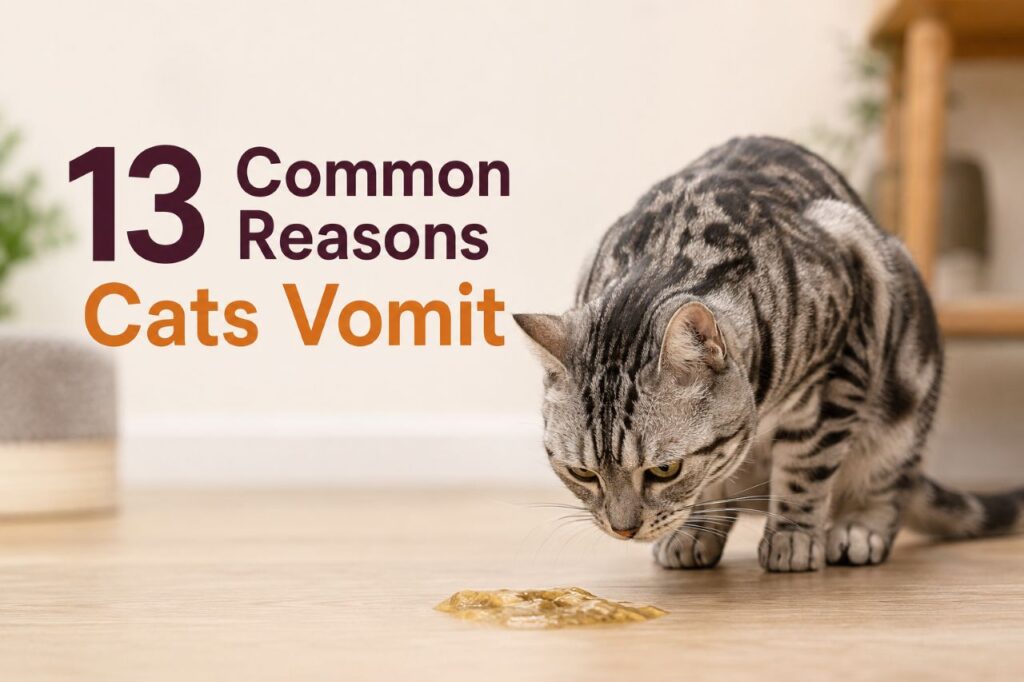
13 Common Reasons Cats Vomit
1. Eating Too Fast
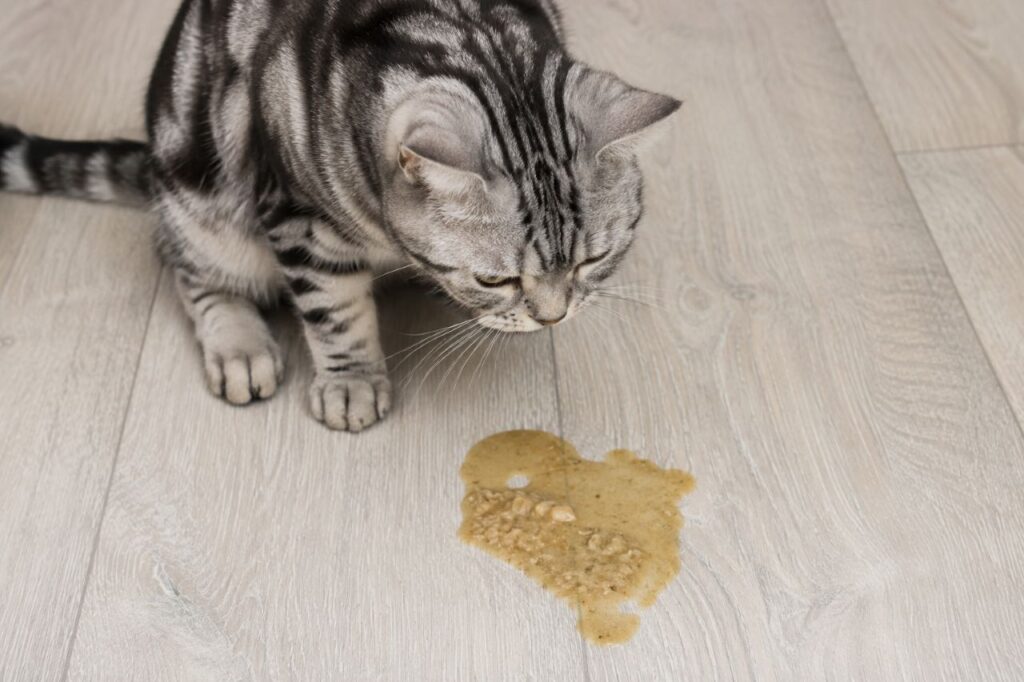
Some cats eat like the food bowl is about to sprint away. When a cat gulps food too quickly, the stomach may push it back up soon after eating.
This is one of the most common reasons for a cat vomiting after eating. The vomit may contain whole kibble or partially digested food.
What may help:
- Use a slow feeder bowl
- Feed smaller meals more often
- Try a puzzle feeder
- Separate cats during meals if one cat eats too fast because of competition
If your cat vomits after almost every meal, do not assume speed is the only problem. Frequent vomiting after eating can also happen with food intolerance, esophageal issues, obstruction, or digestive disease.
2. Hairballs
Hairballs happen when cats swallow fur during grooming. Long-haired cats and heavy groomers are more likely to bring up hairballs.
An occasional hairball may not be a crisis. But frequent cat hairball vomiting is not something to shrug off. Cornell notes that while hairballs are a common and often benign cause of vomiting, a hairball that moves into the intestinal tract may cause a dangerous blockage.
Watch for:
- Repeated gagging with no hairball
- Loss of appetite
- Constipation
- Lethargy
- Vomiting more often than usual
Regular brushing, hairball diets, and vet-approved hairball remedies may help. Never give oils, laxatives, or human products unless your vet says they are safe for your cat.
3. Sudden Food Changes
Cats are creatures of habit. Their stomachs often agree.
Switching food too quickly can cause a cat throwing up, soft stool, gas, or appetite changes. A diet change should usually happen slowly over 7 to 10 days, unless your veterinarian gives different instructions.
A simple transition plan:
- Days 1 to 2: 75% old food, 25% new food
- Days 3 to 4: 50% old food, 50% new food
- Days 5 to 6: 25% old food, 75% new food
- Day 7 onward: 100% new food
Some cats need an even slower switch. Their stomachs are tiny velvet bureaucracies.
4. Food Intolerance or Food Allergy
A cat may vomit because a certain ingredient does not sit well. Food intolerance can cause vomiting, diarrhea, gas, itchy skin, ear problems, or chronic digestive upset.
Common triggers may include specific proteins, additives, or treats. This does not mean grain-free or raw food is automatically better. It means your cat needs the right diet for their body.
Your vet may suggest a prescription elimination diet or a limited-ingredient diet trial. Do not bounce between five foods in two weeks. That can make the mystery harder to solve.
5. Spoiled Food, Trash, or “Forbidden Snacks”
Cats are picky until they are not. Some cats nibble spoiled food, chew plants, steal dairy, lick grease, or sample something they should have left alone.
Dietary indiscretion can cause short-term vomiting. But some foods and household items are genuinely dangerous. Cornell lists spoiled cat food, human medications, string, yarn, antifreeze, chocolate, onions, rubber bands, and other objects as possible vomiting triggers or hazards.
If your cat may have eaten medication, chemicals, lilies, antifreeze, or anything questionable, do not wait to “see what happens.” Call your veterinarian or a poison control hotline.
6. Toxic Plants or Household Poisons
Vomiting can be an early sign of poisoning. Lilies are one of the biggest dangers for cats. The ASPCA warns that true lilies, including Easter lilies, Asiatic lilies, Stargazer lilies, Oriental lilies, and daylilies, can cause severe kidney injury in cats. Even drinking vase water or grooming pollen off the fur may be dangerous.
Other risks include:
- Human pain medications
- Rodent poison
- Insecticides
- Antifreeze
- Essential oils
- Certain flea products made for dogs
- Toxic houseplants
- Cleaning products
The ASPCA Poison Control Center is available 24/7 at 888-426-4435 for animal poison emergencies. A consultation fee may apply. Do not try to make your cat vomit at home unless a veterinarian or poison control expert tells you to. Some substances can cause more damage coming back up.
7. Foreign Object Ingestion
Cats may swallow string, thread, dental floss, ribbon, rubber bands, toy pieces, foam, hair ties, or small objects. These can get stuck in the stomach or intestines.
This is a serious reason for a cat vomiting repeatedly. String is especially scary because it can bunch up the intestines. If you see string hanging from your cat’s mouth or rear end, do not pull it. Call a vet immediately.
Warning signs include:
- Repeated vomiting
- No appetite
- Hiding
- Painful belly
- Constipation
- Drooling
- A cat throwing up undigested food hours after eating
A blockage can become life-threatening and may require surgery.
8. Parasites
Roundworms and other intestinal parasites can cause vomiting, diarrhea, poor coat quality, weight loss, bloating, or visible worms in vomit or stool.
Kittens, outdoor cats, hunters, and cats with unknown deworming history are at higher risk. Catsoria notes that roundworms are the most common worms seen in cat vomit, and a cat who vomits worms should be treated by a veterinarian.
Bring a fresh stool sample to the vet if possible. It is not glamorous, but it helps.
9. Infections
Viral, bacterial, and other infections can upset the stomach. Vomiting may come with diarrhea, fever, poor appetite, sneezing, eye discharge, or lethargy.
Kittens and unvaccinated cats are more vulnerable to serious infectious disease. If your cat is young, weak, dehydrated, or vomiting repeatedly, skip the home guessing game and call the vet.
10. Constipation
Constipation can make a cat vomit because the digestive tract is not moving normally. A constipated cat may strain in the litter box, produce small dry stools, cry, visit the box often, or stop eating.
This can be easy to miss in multi-cat homes. If you are not sure who is using the litter box, you may need to separate cats briefly so you can monitor stool and urine. Never give human laxatives or enemas without veterinary direction. Some products are toxic to cats.
11. Inflammatory Bowel Disease
Inflammatory bowel disease, often called IBD, can cause chronic vomiting, diarrhea, weight loss, appetite changes, and poor coat condition.
A cat with IBD may seem fine between episodes, which makes owners delay care. The pattern often looks like “my cat throws up every few weeks” or “my cat has always had a sensitive stomach.”
Chronic vomiting deserves a vet visit. Your vet may recommend blood work, fecal testing, imaging, diet trials, or other diagnostics.
12. Pancreatitis
Pancreatitis is inflammation of the pancreas. In cats, it can be sneaky. Some cats vomit. Others mainly show poor appetite, lethargy, weight loss, dehydration, or belly pain.
Because the signs are vague, pancreatitis is not something you can diagnose by looking at the carpet. Cats with suspected pancreatitis need veterinary care, and some need fluids, nausea medication, pain control, and nutrition support.
13. Kidney Disease, Diabetes, Hyperthyroidism, or Liver Disease
Vomiting can come from problems outside the stomach. Catsoria lists kidney disease, diabetes, hyperthyroidism, liver disease, pancreatitis, cancer, medications, infections, and other conditions among possible causes of vomiting in cats.
Pay close attention if vomiting comes with:
- Weight loss
- Drinking more water
- Peeing more or less than usual
- Bad breath
- Poor coat
- Restlessness
- Increased hunger with weight loss
- Weakness
- Yellow gums or eyes
These signs are especially important in middle-aged and senior cats. A “sensitive stomach” in a 12-year-old cat may actually be a medical clue wearing whiskers.
What Your Cat’s Vomit Color May Mean
Your specific cat vomit color does not give a perfect diagnosis, but it can help your vet decide where to start. Take a photo before cleaning it up if you can stomach the task.
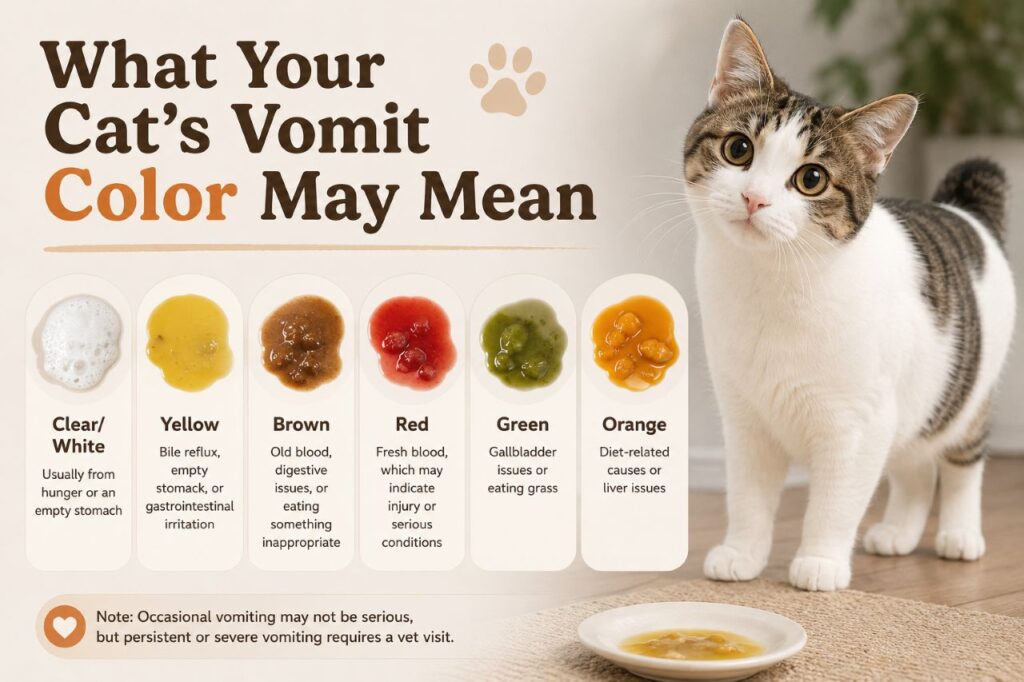
| Vomit Appearance | Possible Meaning |
| Cat vomiting yellow liquid | Often bile, sometimes from an empty stomach, nausea, pancreatitis, or digestive disease |
| Cat vomiting white foam | May happen with stomach irritation, nausea, or an empty stomach |
| Clear liquid | Could be stomach fluid, water, regurgitation, or nausea |
| Undigested food | Eating too fast, food intolerance, stomach irritation, delayed stomach emptying, or obstruction |
| Hairball | Swallowed fur, overgrooming, long coat, or possible digestive motility issue |
| Red blood | Irritation, ulcer, injury, toxin, or repeated vomiting |
| Black or coffee-ground material | Possible digested blood, needs urgent veterinary attention |
| Green vomit | May contain bile or material from the small intestine |
| Worms | Parasites, needs deworming and veterinary guidance |
Catsoria both note that vomit appearance can offer clues, but it does not confirm the cause on its own.
What to Do at Home After One Mild Vomiting Episode
If your adult cat vomits once, then acts normal, wants food, drinks normally, and has no other symptoms, you can monitor closely.
Here is a safe, practical plan:
- Clean the vomit and check it. Look for hair, worms, blood, string, plant pieces, plastic, or unusual color.
- Remove food for a short period only if your vet says that is appropriate for your cat. Do not fast kittens, diabetic cats, senior cats, underweight cats, or cats with repeated vomiting without veterinary advice.
- Offer small amounts of water. If your cat vomits water too, call the vet.
- Reintroduce food gently. Try a small portion of the regular diet or a vet-recommended bland or digestive diet.
- Keep your cat indoors and quiet while you monitor.
- Call your vet if vomiting returns, your cat stops eating, or anything feels off.
Do not give human nausea medicine, antacids, pain relievers, Pepto-Bismol, essential oils, or leftover pet medication. Cats are not tiny humans in fur pajamas. Their bodies handle medications very differently.
When to Take Your Cat to the Vet for Vomiting
Knowing when to take cat to vet for vomiting is key to preventing severe illness. Book a vet visit if:
- Your cat vomits more than once a week
- Vomiting happens repeatedly after meals
- Your cat is losing weight
- Your cat has diarrhea
- Your cat is drinking or peeing more
- Hairballs are frequent
- Your cat’s appetite has changed
- Your cat is a kitten, senior, or has a known illness
- You suspect parasites
- You see worms, blood, or black material
- You think your cat ate something unsafe
Catsoria recommends calling your veterinarian right away if a cat vomits two to three times in a row, has other symptoms such as not eating or diarrhea, does not eat or drink for 12 hours after repeated vomiting, has a known illness, or vomits worms.
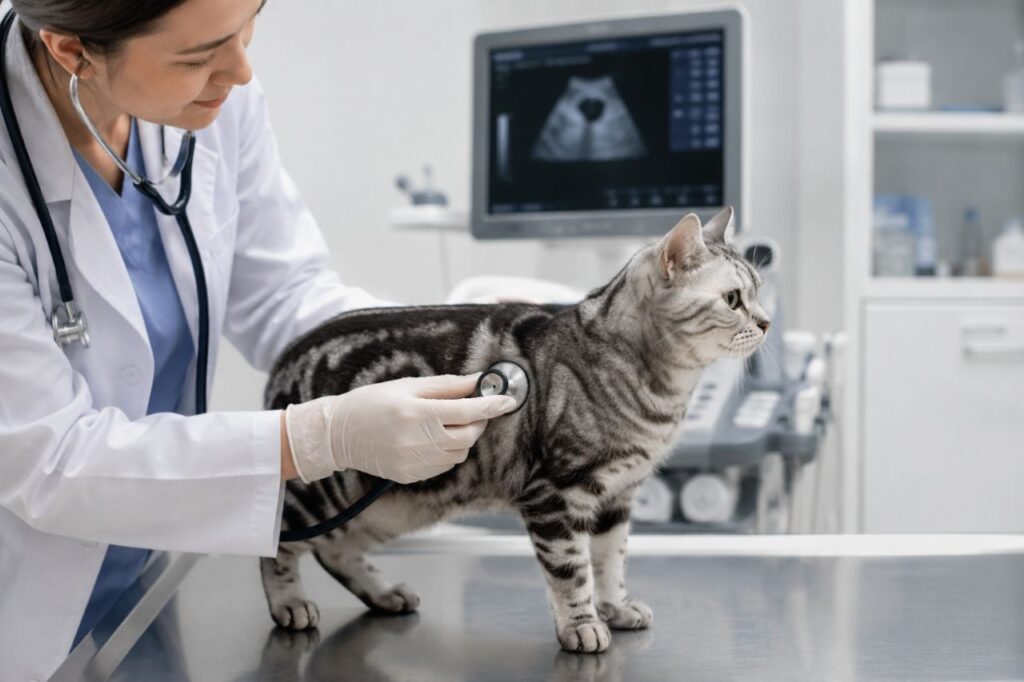
How Vets Diagnose Cat Vomiting
Your vet will start with questions. Be ready to answer:
- When did the vomiting start?
- How many times has your cat vomited?
- What did the vomit look like?
- Is your cat eating and drinking?
- Any diarrhea or constipation?
- Any weight loss?
- Any new food, treats, medicine, plants, or cleaners?
- Could your cat have eaten string, ribbon, or a toy?
- Is your cat indoor, outdoor, or both?
Testing may include a physical exam, blood work, urinalysis, fecal testing, X-rays, ultrasound, or other diagnostics. Cornell notes that diagnosing frequent vomiting may begin with history, physical exam, bloodwork, fecal exam, and sometimes imaging such as X-rays or ultrasound.
How Cat Vomiting Is Treated
Treatment depends on the cause. There is no one-size-fits-all cure for cat throwing up.
Your vet may recommend:
- Anti-nausea medication
- Fluids for dehydration
- Deworming medication
- A prescription digestive diet
- Diet trials for food sensitivity
- Treatment for kidney disease, diabetes, hyperthyroidism, or IBD
- Imaging or surgery for a blockage
- Hospital care for poisoning, severe dehydration, or serious illness
Catsoria notes that mild cases may be treated with fluids, supportive care, and a bland or gastrointestinal diet, while dehydrated or severely ill cats may need hospitalization and IV fluids.
How to Help Prevent Vomiting in Cats
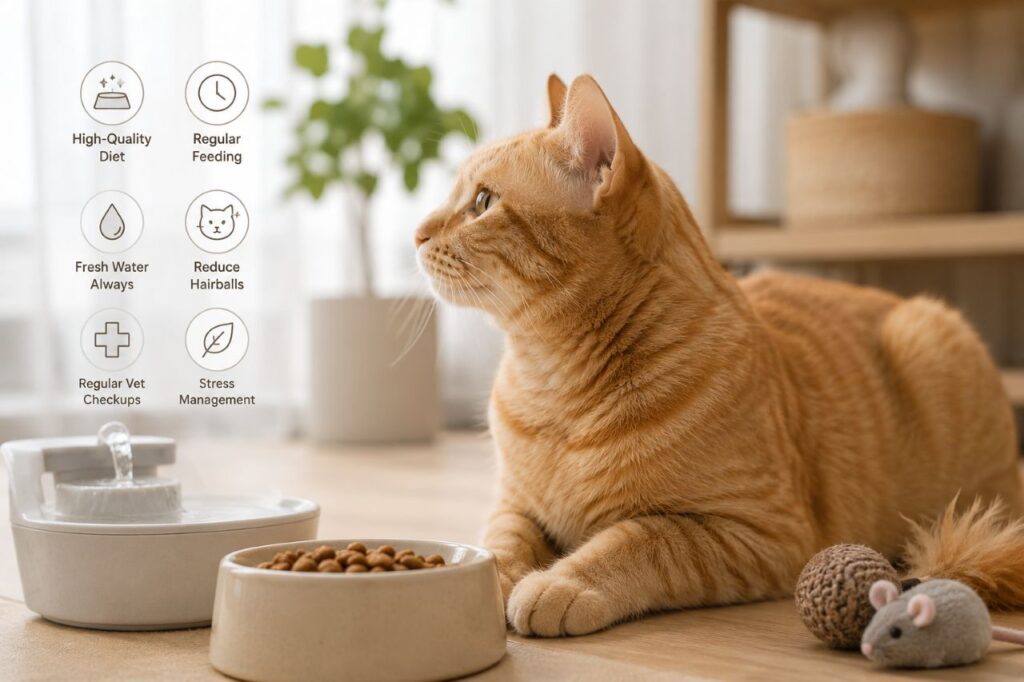
You cannot prevent every hairball or stomach upset, but you can lower the odds.
- Brush your cat often. This matters most for long-haired cats and heavy shedders.
- Feed measured meals. Free-feeding can work for some cats, but others do better with smaller meals.
- Use a slow feeder. This helps cats who inhale kibble like a furry vacuum.
- Make diet changes slowly. Give the gut time to adjust.
- Keep string and ribbon away. This includes gift wrap ribbon, sewing thread, yarn, dental floss, and hair ties.
- Choose cat-safe plants. Check plants through a reliable toxic plant database before bringing them home.
- Keep medications locked up. Human medications are a major pet hazard.
- Schedule regular wellness exams. Blood work can catch kidney disease, diabetes, thyroid disease, and other issues earlier.
- Watch patterns. A vomiting log can be surprisingly useful. Track date, time, food, vomit appearance, appetite, stool, and behavior.
Final Thoughts
A cat may vomit from eating too fast, hairballs, food changes, parasites, toxins, foreign objects, infections, or chronic disease. One isolated episode in a bright, hungry, normal-acting adult cat may be something to monitor. Repeated vomiting, blood, weakness, appetite loss, diarrhea, weight loss, suspected poisoning, or vomiting in a kitten or senior cat deserves veterinary care.
The best rule is simple: when your cat’s vomiting feels unusual, frequent, or paired with behavior changes, call your vet. Cats are experts at hiding illness. Vomiting is one of the moments when the curtain slips.
Frequently Asked Questions
1. Why is my cat vomiting undigested food?
A cat throwing up undigested food may happen because your cat ate too fast, ate too much, has food intolerance, or regurgitated food from the esophagus. It can also happen with stomach irritation, delayed stomach emptying, or a blockage. If it happens often, call your vet.
2. Why is my cat vomiting yellow liquid?
A cat vomiting yellow liquid usually means bile is present. This may happen when the stomach is empty, but it can also appear with nausea, pancreatitis, inflammatory bowel disease, or other digestive problems. If it happens repeatedly, your cat needs a vet exam.
3. Why is my cat vomiting white foam?
A cat vomiting white foam can happen when the stomach is irritated or empty. It may also show up with gastritis, hairballs, food intolerance, or other illness. White foam by itself is not a diagnosis.
4. Is it normal for cats to vomit hairballs?
An occasional hairball may happen, especially in long-haired cats. Frequent hairballs are not ideal. They may point to overgrooming, skin irritation, anxiety, or digestive motility problems.
5. Why is my cat vomiting after eating?
Your cat vomiting after eating may be due to eating too fast, eating too much, reacting to food, or regurgitating. Repeated vomiting after meals can also be linked to obstruction, digestive disease, or esophageal problems.
6. Should I feed my cat after vomiting?
If your cat vomited once and seems normal, ask your vet whether a short food pause and small meal reintroduction is appropriate. Do not fast kittens, diabetic cats, senior cats, sick cats, or cats who keep vomiting without veterinary guidance.
