


The lights are off. The house is quiet. You have finally found the cool side of the pillow.
Then it starts.
“Meow.”
You wait.
“Meeooow.”
By the fourth round, your cat is standing in the hallway performing what sounds like a one-animal opera for an audience that did not buy tickets.
So, why do cats meow at night?
Most nighttime meowing happens because a cat is active, hungry, bored, lonely, stressed, or looking for attention. Cats may also react to animals outside, changes in the home, mating instincts, or a closed door. In older cats, new nighttime yowling can be connected to pain, hearing or vision loss, hyperthyroidism, high blood pressure, kidney disease, or cognitive decline.
The sound may be inconvenient, but it is rarely meaningless. Your cat is communicating. The real job is figuring out whether the message is “feed me,” “play with me,” “something scared me,” or “I do not feel right.”
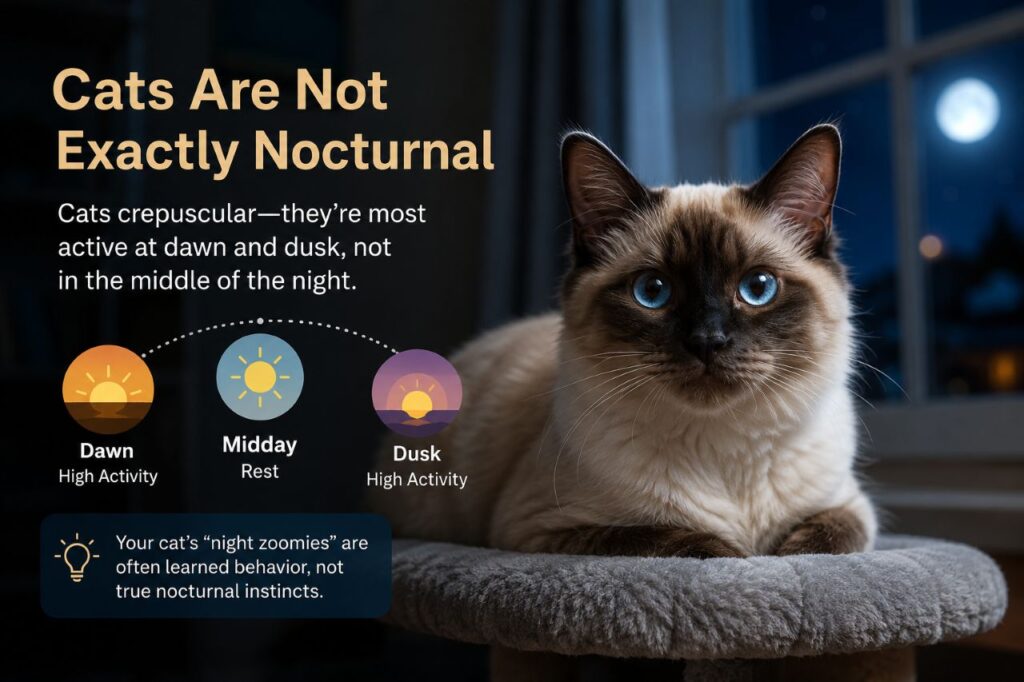
Cats Are Not Exactly Nocturnal
Cats are often described as nocturnal animals, but that is not quite accurate.
They are usually crepuscular, meaning they tend to be most active around dawn and dusk. Those are useful hunting hours for a small predator. Rodents and other prey are moving, the light is low, and the world is quieter.
A house cat may live indoors, eat from a ceramic bowl, and sleep on a blanket with their name embroidered on it. The old hunting rhythm is still there. That is why some cats race through the hallway before sunrise, knock a toy under the refrigerator at midnight, or begin calling just as everyone else is settling down. PetMD and Purina both note that evening and early-morning activity can be part of a cat’s natural daily pattern.
Normal activity does not mean you must accept nightly wake-up calls forever. A cat’s routine can often be shifted with better timing, more daytime activity, and consistent responses. Before trying to change the behavior, though, look for the reason behind it.
What Kind of Sound Is Your Cat Making?
People use “meowing,” “crying,” and “yowling” as though they mean the same thing. The sound itself can offer a clue:
- A short meow may be a greeting or request.
- Repeated meows often mean the cat is asking for something.
- A long, drawn-out yowl can be linked to distress, mating behavior, territorial tension, confusion, or pain.
- Caterwauling is louder and more dramatic. It can sound like a mix of a howl, whine, and wail. Cats may caterwaul when seeking a mate, confronting another cat, or trying to signal that something is wrong.
Adult cats use meowing largely to communicate with people. Kittens meow to their mothers, but grown cats do not usually rely on ordinary meows when communicating with other cats. They have scent, posture, facial expressions, and other sounds for that. Humans, on the other hand, respond well to noise. Cats noticed.
Listen for changes in pitch, volume, and urgency. A familiar breakfast meow is different from a low, unfamiliar howl coming from the litter box.
Your Cat Still Has Energy to Burn
A cat that sleeps through most of the day may be fully charged by bedtime.
Indoor cats do not need to chase mice for dinner or patrol several acres of territory. Without enough play and exploration, their physical energy has nowhere to go. Their brains also need work. A bowl of food and a soft couch cover basic needs, but they do not provide much of a challenge. Night arrives, the humans disappear, and the cat is ready to do something.
This is a common explanation for a young or healthy cat meowing at night, especially when the vocalizing comes with zoomies, toy carrying, door scratching, or attempts to wake family members.
A few minutes of lazy string wiggling may not be enough. Good feline play looks more like hunting. Let your cat stalk, chase, leap, hide, and catch the toy. Move a wand toy along the floor and around furniture rather than waving it directly in the cat’s face.
Short sessions can work better than one long workout. Try play in the morning, another round after work, and a focused session before bed. Do not force your cat to stay awake all day. Cats naturally sleep for many hours, and interrupting every nap can create stress. The goal is to add meaningful activity, not appoint yourself as director of feline sleep deprivation.
Regular daytime enrichment and evening play can help move more of your cat’s active period into hours that suit the household.
Hunger Has Excellent Timing
Some cats wake their owners because they are genuinely hungry. Others have learned that humans are remarkably easy to operate before sunrise.
Think about your cat’s feeding schedule. A cat who eats dinner at 5 p.m. may be ready for another meal long before breakfast. Kittens, highly active cats, and cats eating small portions may become hungry sooner.
Do not simply add extra calories. Weight gain creates a much larger problem than early-morning noise. Instead, divide the cat’s normal daily food allowance into several smaller meals. A portion can be offered near bedtime.
A timed feeder can release another small meal during the night or early morning without teaching the cat that screaming summons a human server. An automatic feeder is especially useful when the meowing happens at nearly the same time each night. Set it to open shortly before the usual performance begins. Over time, the cat may wait near the feeder instead of your face.
Check the water bowl too. Make sure clean water is available and easy to reach. A cat with increased thirst, increased urination, weight loss, or a sudden increase in hunger needs a veterinary exam rather than a larger midnight buffet. Kidney disease, diabetes, and hyperthyroidism can change appetite and thirst.

Meowing May Have Worked Before
Cats repeat behaviors that produce results.
Your cat meows outside the bedroom. You open the door. The next night, your cat meows again. You offer a little food because you need to sleep. Now the cat has discovered a system.
Even scolding can reward attention-seeking behavior. You got up, spoke, looked at the cat, and joined the midnight conversation. From the cat’s perspective, the button worked.
This is where nighttime meowing becomes difficult. You cannot safely ignore every vocalization without checking for physical or environmental problems. Once your veterinarian has ruled out illness and you know your cat has food, water, a clean litter box, and a safe environment, consistency matters.
Do not feed, play, pet, or open a door in direct response to attention-seeking meowing. Give those things when the cat is quiet.
The timing is important. Wait for a brief pause, even if it lasts only a few seconds, before offering attention in the morning. Your cat should learn that quiet behavior opens the human vending machine.
Expect the meowing to get louder for a while. A behavior that used to work may intensify when it suddenly stops working. The cat is essentially trying the button harder. One sleepy family member giving in at 3 a.m. can restart the pattern.
The Bedroom Door Is the Problem
Some cats tolerate closed doors about as well as water tolerates staying in a bathtub during cat bath day.
A cat meowing outside bedroom door lines up with their desire to control their territory. A closed bedroom door blocks access to you, a preferred sleeping area, or part of the cat’s domain. The cat may scratch, paw, and meow because the normal route has disappeared.
Decide on one household rule. Letting the cat into the bedroom on some nights but excluding them on others creates confusion. The cat has no reason to stop trying because access occasionally returns.
When the bedroom must stay cat-free, make the space outside it more appealing. Provide a comfortable bed, water, litter box access, a scratching surface, and a few safe toys. A heated pet bed can be useful for cats that seek the warmth of a sleeping person, provided it is designed for pets and used according to its safety instructions.
Start the new routine before bedtime rather than shutting the door and hoping for a miracle. Play with your cat, offer the final meal, guide them toward their sleeping area, and reward calm behavior there. A new kitten may need more gradual adjustment. Sudden isolation in an unfamiliar home can be frightening.
Why Is My New Cat Meowing at Night?
A newly adopted cat has lost every familiar scent, sound, hiding spot, and routine at once.
During the day, activity in the home may distract them. At night, the silence makes the unfamiliar space feel larger. The cat may call because they are uncertain, lonely, or searching for their previous companions.
Give a new cat a quiet starter room rather than immediate access to the entire house. The room should contain food, water, a litter box placed away from the food, hiding options, a scratching surface, and a comfortable bed.
Spend calm time in the room during the day. Do not drag the cat from hiding or force physical contact. Let them approach. A piece of bedding carrying a familiar scent may help. Keep feeding, play, and bedtime routines predictable. Many newly adopted cats become quieter as the home starts to smell and feel familiar.
Persistent crying accompanied by refusal to eat, diarrhea, vomiting, labored breathing, litter box trouble, or extreme withdrawal warrants veterinary advice.
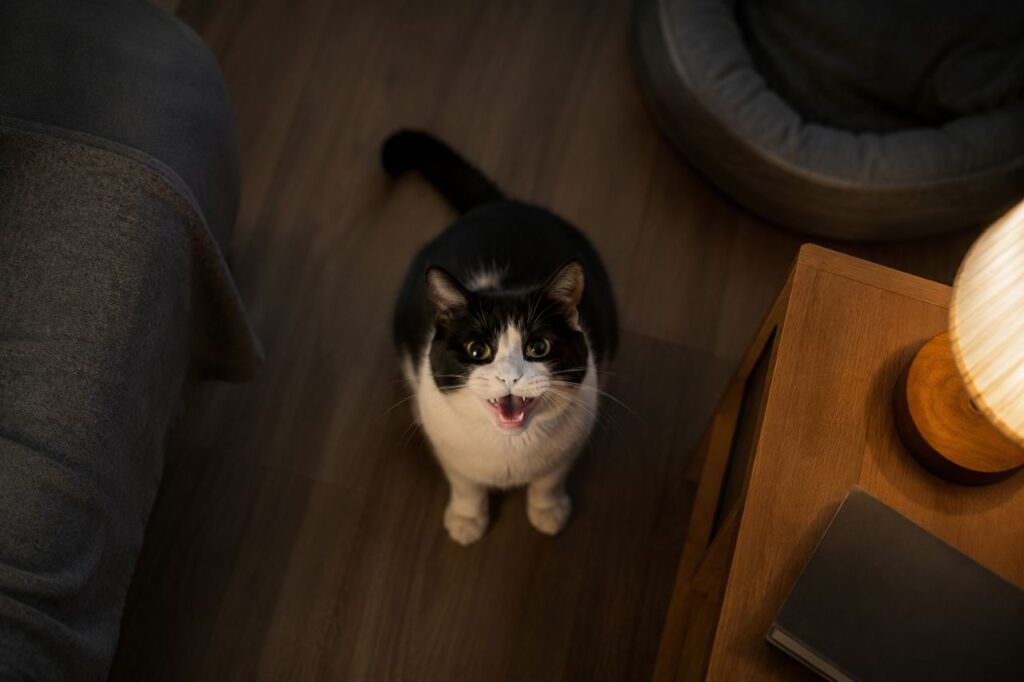
A Kitten Crying at Night May Need Reassurance
Young kittens are used to sleeping with their mother and littermates. A new home can feel cold and strangely empty.
Place the kitten crying at night in a warm, secure area. A soft blanket and a pet-safe warming product may help, but the kitten must be able to move away from the heat. Never use an unprotected heating pad or hot water bottle that could burn delicate skin.
Play before bedtime, then offer an age-appropriate meal. Make sure the litter box has low sides and is easy to find.
Very young kittens need frequent feeding and close supervision. Their care schedule cannot always be adjusted around a full night of human sleep. Follow the feeding plan provided by your veterinarian or rescue organization.
A kitten that cries constantly, feels cold, appears weak, refuses food, has diarrhea, or struggles to breathe needs prompt veterinary attention. Do not assume every sound is loneliness.
Something Outside Has Your Cat’s Attention
Your house may feel quiet to you. Your cat is working with sharper hearing, a sensitive nose, and a window overlooking the night shift.
Outdoor cats, raccoons, rodents, insects, passing vehicles, sprinklers, tree branches, and unfamiliar smells can all trigger vocalizing. A cat may sit at a window and chirp, growl, howl, or pace because another animal is nearby.
Look at where your cat goes when the meowing starts:
- A cat calling beside the back door may be reacting to outdoor activity.
- One patrolling windows may have seen another cat.
- A cat staring at the ceiling might hear mice or movement in the attic.
Close blinds or curtains at night when outdoor animals are causing agitation. Privacy film can block a lower window view without darkening the room completely. Motion-activated outdoor devices may discourage visiting animals, but avoid anything that can harm or trap wildlife.
White noise can mask some household sounds, though it should be kept at a comfortable volume. Cats hear frequencies people do not, so a sound that seems soft to you may still be irritating. Environmental noises and animals outside are recognized triggers for nighttime vocalizing.
Stress Can Get Louder After Dark
Cats notice changes that people consider minor. A different work schedule, new furniture, overnight guests, construction, a new pet, or a moved litter box can unsettle a sensitive cat. Night may be when that uncertainty becomes most obvious.
Signs of stress do not look identical in every cat. One cat hides. Another becomes clingy. Another walks through the house calling. You may also see reduced appetite, overgrooming, urine marking, irritability, crouched posture, or increased vigilance. Excessive vocalization can be part of feline anxiety.
Restore as much predictability as possible. Feed at regular times. Keep litter boxes and resting places accessible. Give the cat somewhere elevated to watch the room and somewhere enclosed to disappear from it.
In a multicat home, make sure one cat is not blocking another from food, water, litter boxes, doorways, or sleeping spots. Tension can be quiet. There may be no dramatic fights, just staring, stalking, chasing, or guarding resources.
A useful litter box guideline is one box per cat, plus one extra, placed in separate areas rather than lined up as a single bathroom complex. Pheromone products may help some cats feel more secure, but they do not replace medical care or changes to a stressful environment.
Unspayed Cats Can Be Extremely Vocal
An unspayed female cat in heat may produce long, persistent cries, often while rolling, rubbing against objects, raising her hindquarters, or trying to escape outside. The sound can be startling. Many first-time cat owners think their cat is injured.
Male cats may also yowl when they smell a female in heat or detect another male near their territory. Urine marking, restlessness, roaming attempts, and fighting may come with the noise.
Spaying and neutering stop heat cycles and usually reduce mating-related calling, roaming, and some forms of territorial behavior, though learned habits may not disappear overnight. Keep unspayed and unneutered cats securely indoors. An open window screen is not a reliable barrier for a determined cat.
Senior Cats Often Need a Closer Look
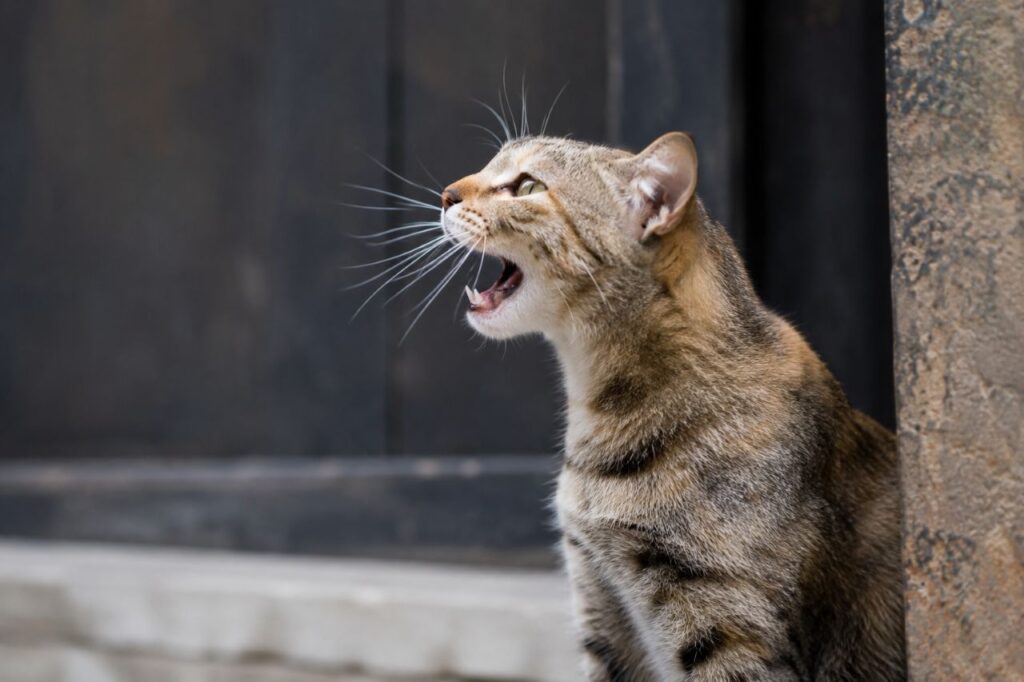
A senior cat meowing at night should not be dismissed as simply old age.
Older cats may become disoriented after dark. Vision or hearing loss can make it harder to locate people, move through the house, or understand what is happening. Some cats call until they hear a familiar voice.
Cognitive dysfunction can change sleep patterns, memory, social behavior, and awareness. Affected cats may wander, stare at walls, become trapped behind furniture, forget familiar routines, eliminate outside the litter box, or vocalize for no clear reason.
Nighttime calling can also occur in cats with hyperthyroidism or high blood pressure. Pain from arthritis or dental disease may make it hard to rest comfortably. Kidney disease can increase thirst and litter box trips.
Cornell’s Feline Health Center notes that old cat yowling at night may be associated with cognitive dysfunction as well as medical problems including hyperthyroidism and hypertension.
Book a veterinary appointment when an older cat develops new or louder vocalization. A physical exam, bloodwork, urine testing, and blood pressure measurement may be recommended.
Home Adjustments for Senior Cats:
- Use night-lights near beds, stairs, water bowls, and litter boxes.
- Place resources where the cat can reach them without climbing.
- A low-entry litter box helps cats with stiff joints.
- Keep furniture arrangements stable so a cat with declining vision can navigate from memory.
Do not punish a confused cat for waking you. They are not staging a protest. They may be trying to find their bearings.
Pain and Illness Can Change a Cat’s Voice
Cats often hide discomfort. A change in vocal behavior may be one of the few early signs.
Pain from arthritis, dental disease, injury, abdominal problems, or urinary disease can cause restlessness and calling. Conditions that increase hunger, thirst, blood pressure, or confusion can also make a cat more vocal.
When to Schedule a Veterinary Exam:
- A normally quiet cat suddenly begins meowing at night.
- The sound is lower, louder, or more urgent than usual.
- Your cat seems restless or cannot get comfortable.
- Appetite, weight, thirst, or litter box habits have changed.
- Your cat hides more, avoids touch, or becomes irritable.
- Jumping, walking, or using stairs looks difficult.
- The meowing continues despite changes to play, feeding, and routine.
A sudden increase in meowing should be investigated rather than treated as a training problem.
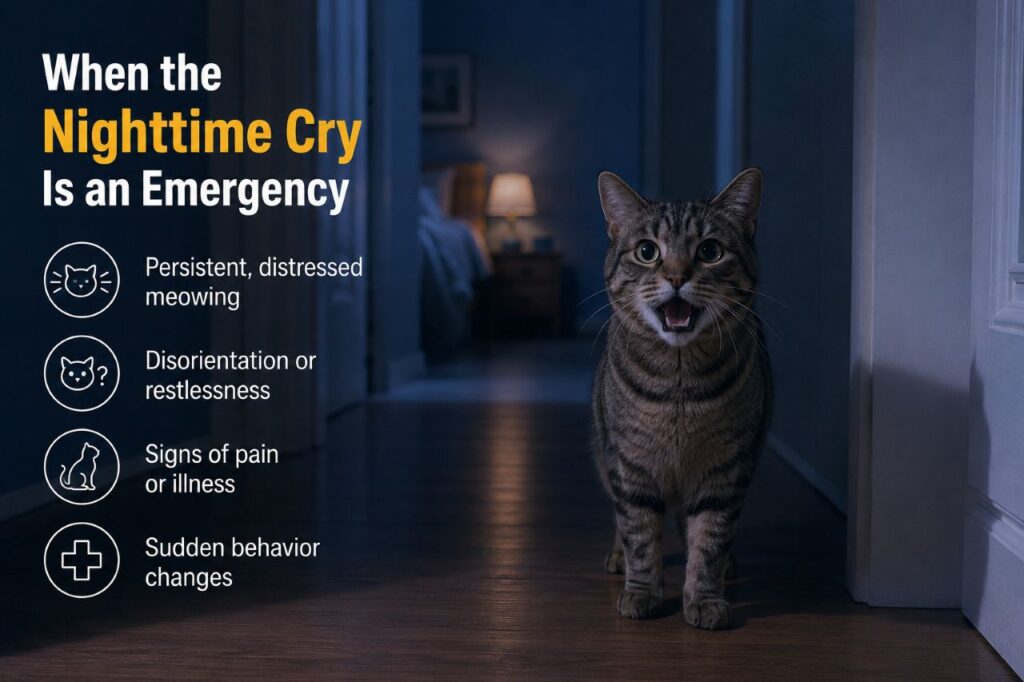
When the Nighttime Cry Is an Emergency
Immediate Veterinary Care Required: Go to an emergency veterinarian when vocalizing comes with difficulty breathing, collapse, seizures, repeated vomiting, severe weakness, or an inability to urinate.
Repeated trips to the litter box with straining, crying, or little to no urine can signal a urinary blockage. This is especially dangerous in male cats and requires immediate treatment. Do not wait until morning when your cat is open-mouth breathing, struggling for air, collapsing, or unable to pass urine.
How to Stop a Cat From Meowing at Night
The solution depends on why the biting or meowing occurs. There is no single trick because there is no single cause. Start with a veterinary check when the behavior is new, intense, or happening in a senior cat. Once health problems have been ruled out, work on the cat’s daily rhythm and the results their meowing produces.
Build a Better Evening Routine
A useful bedtime sequence follows a natural pattern: Hunt, catch, eat, groom, sleep.
Begin with active play. Let the cat chase and catch a toy several times. End the session with a small meal taken from the cat’s normal daily allowance. Many cats groom and rest after eating. It is not a sleeping pill, but it gives the evening a satisfying ending. Run the routine at roughly the same time each night.
Add More Life to the Day
Leave out safe toys that your cat can use alone, but rotate them so they do not become part of the furniture. Puzzle feeders turn part of a meal into a small job. Cardboard boxes, paper bags without handles, cat trees, scratchers, tunnels, and window perches create more choices. Hide a few pieces of kibble in approved places. Let the cat search, climb, scratch, and solve.
Keep Food From Becoming Your Wake-Up Call
Do not get out of bed and feed your cat while they are meowing. That turns noise into a successful hunting strategy. Use a timed feeder when hunger is part of the pattern. Gradually move its opening time later if the cat has been demanding breakfast earlier and earlier. Measure the full day’s food—timed meals still count toward daily calories.
Reward Quiet Moments
Give attention, play, food, and access to desired spaces when your cat is calm. You do not need a long period of silence at the beginning. Catch two or three quiet seconds and reward those. When morning arrives, wait for a gap in the meowing before getting up or serving breakfast. Otherwise, the final meow becomes the one that worked.
Do Not Punish the Noise
Yelling may add stress and still provide attention. Spraying water can make the cat fearful of you without teaching them what to do instead. Punishment is especially unfair when vocalizing is connected to pain, fear, sensory loss, or confusion. Solve the reason, teach the replacement behavior, and protect your sleep without turning bedtime into a feud.
A Simple Nighttime Checklist
Before going to bed, check the ordinary things:
- Fresh water is available
- The litter box is clean and accessible
- Doors have not trapped the cat away from food or the box
- The cat has had play and social contact
- The final meal fits the feeding plan
- Curtains are closed when outside animals cause agitation
- A senior cat has clear paths and gentle lighting
- Toys left out overnight are safe for unsupervised use
Safety Reminder: Do not leave string, ribbon, elastic bands, feather wands, or toys with small detachable pieces where a cat can swallow them overnight.
Why Does My Cat Walk Around Meowing at Night?
A cat walking through the house while calling may be searching for you, checking territory, reacting to a sound, or looking for access to a room.
In senior cats, wandering and calling can reflect confusion, sensory decline, or cognitive dysfunction. The cat may seem to forget where they are and then settle once they see or hear a familiar person.
Watch the route. A cat who repeatedly walks between you and the food bowl is making a fairly specific request. A cat moving between windows may be responding to something outside. Aimless wandering deserves more attention, particularly when it is new.
Why Does My Cat Meow at the Same Time Every Night?
Cats have strong internal routines. The timing may line up with hunger, an automatic outdoor light, another cat passing the window, a family member going to bed, or the quiet period after household activity stops.
Keep a brief log for a week. Record the time, location, sound, what your cat was doing beforehand, and what happened after you responded. Patterns that felt random often become obvious on paper.
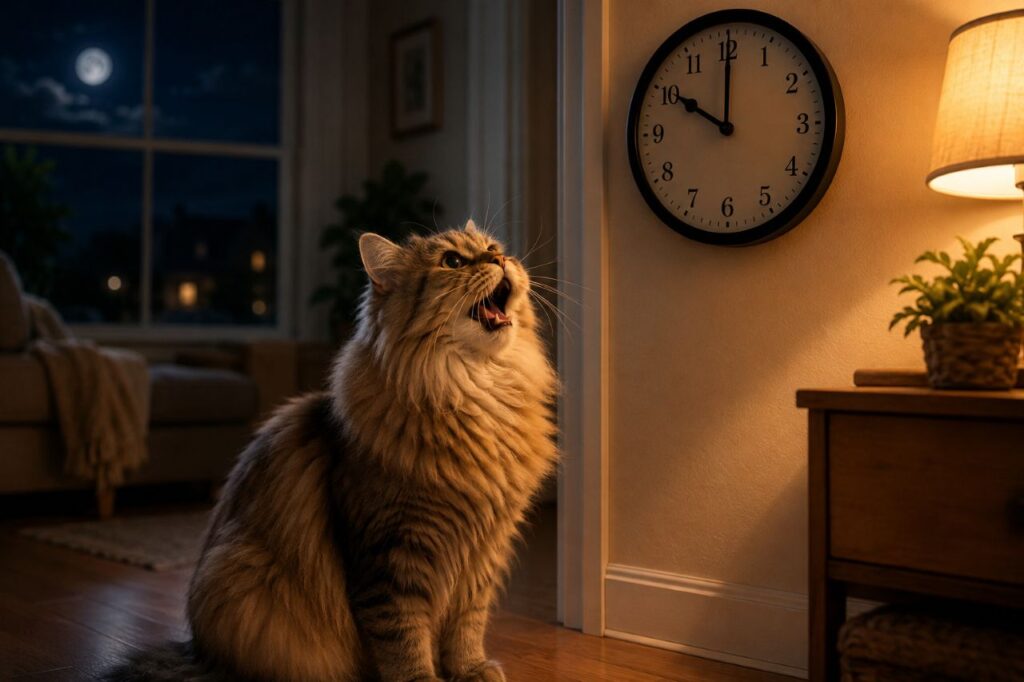
Why Does My Cat Meow Only When the Lights Go Out?
Darkness may remove visual landmarks, especially for an older cat with reduced vision. The end of household activity can also signal that access to attention is about to disappear.
Use a dim night-light and maintain a predictable bedtime routine. Call the cat calmly before turning off the lights so they know where you are. A sudden fear of darkness or new difficulty navigating the home should be discussed with a veterinarian.
Final Thoughts
A cat calling at night may be bored, hungry, unsettled, or simply awake during the hours their body expects activity. Some have trained their families to provide room service before sunrise. Others are reacting to something that deserves medical attention.
Look at the whole cat, not just the noise. Notice when the meowing began, where it happens, what the sound is like, and what your cat does next. Changes in appetite, thirst, weight, movement, sleep, and litter box use matter.
Once illness and pain have been ruled out, a predictable routine usually gives you the best chance of quieter nights: meaningful daytime activity, energetic play before bed, a well-timed meal, comfortable sleeping options, and no rewards for demand meowing. Your cat may never agree that 3 a.m. is an unreasonable hour for a meeting. With a little detective work and consistency, they can learn that the office is closed.
Frequently Asked Questions
1. Should I ignore my cat meowing at night?
Rule out hunger, thirst, litter box problems, fear, pain, and illness before treating the sound as attention-seeking behavior. Once your cat has been medically cleared and their needs are met, how to stop cat from meowing at night relies heavily on ignoring demand meowing. Everyone in the home must respond consistently.
2. Why is my cat suddenly meowing at night?
Sudden vocalization can be caused by stress, environmental changes, pain, illness, or changes in hearing and vision. Schedule a veterinary exam, particularly when the meowing is paired with appetite changes, weight loss, increased thirst, litter box trouble, hiding, or reduced mobility.
3. Why does my cat meow at 3 a.m.?
Your cat may be entering a naturally active part of their daily cycle. Hunger, boredom, outdoor animals, and learned attention-seeking can make the timing more predictable. Evening play, a later meal, and an automatic feeder may help.
4. Why is my old cat yowling at night?
Older cats may yowl because of cognitive dysfunction, pain, high blood pressure, hyperthyroidism, kidney disease, or reduced hearing and vision. New nighttime yowling in a senior cat calls for a veterinary examination.
5. Does leaving a light on help?
A low night-light may help cats with declining vision or nighttime confusion find beds, water, stairs, and litter boxes. Avoid bright lighting that disrupts the household’s normal sleep environment.
6. Will getting another cat stop the meowing?
Not necessarily. A second cat may provide companionship, but introductions can also create stress and competition. Adopting another animal should be a thoughtful long-term decision, not a treatment for nighttime noise.