

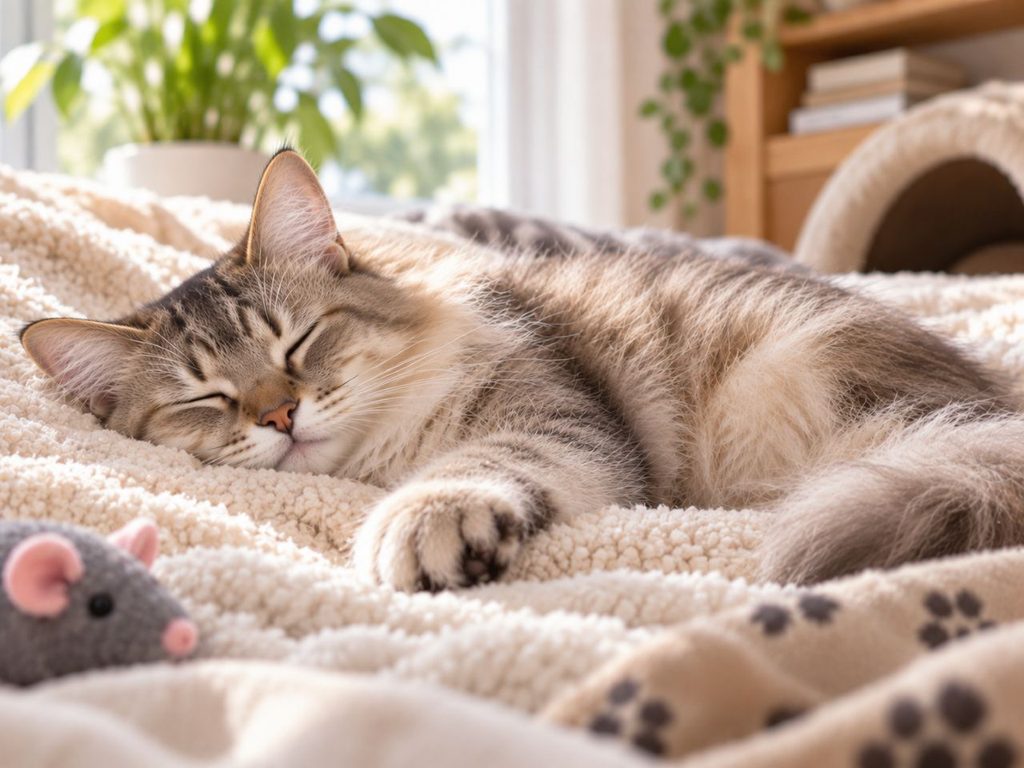
You are sitting beside your sleeping cat when one paw begins to paddle. The whiskers flick, an ear jumps, and the tail gives a tiny thump. It can look funny for a second—and worrying the next.
Most of the time, a cat twitching in sleep is experiencing a normal part of the sleep cycle, especially REM sleep, the stage most closely associated with dreaming. Small, brief movements of the paws, face, ears, whiskers, or tail are usually harmless when the cat stays relaxed and acts normally after waking.
Twitching deserves veterinary attention when it becomes stiff, violent, repetitive, or starts happening while the cat is awake. Drooling, loss of bladder or bowel control, collapse, breathing trouble, or confusion after an episode also point away from ordinary dreaming.
why do cats twitch while sleeping?
Cats move between lighter sleep and deeper stages throughout the day. During REM sleep, the brain is active even though most of the body remains relaxed. Small signals can still reach muscles in the face, paws, ears, and tail, creating the little flicks and jerks you see.
That does not let us know exactly what a cat is dreaming about. Your cat may look as though she is stalking a bird or chasing a toy, but the story behind those movements is our guess. What we can say is that cats enter REM sleep and that brief muscle movements commonly appear during this stage.
What normal sleep twitching looks like
Normal twitching is usually subtle and comes in short bursts. One body part may move, stop, and then move again a little later. Your cat’s overall posture stays loose rather than rigid.
Common sleep movements include:
- Whiskers trembling or fanning forward
- Eyelids fluttering, sometimes with eye movement beneath them
- An ear flicking toward a sound
- Toes flexing or paws making small running motions
- The tip of the tail tapping or curling
- A brief shoulder, leg, or whole-body jerk
- Quiet chirps, squeaks, purrs, or tiny meows
A dreaming cat may breathe a little less evenly for a moment, but the breathing should not look strained. Once awake, the cat should quickly seem like herself: aware of the room, able to walk normally, and free of lingering confusion.
REM sleep is the usual explanation
Cats do not sleep in one long block the way many people do. They take a series of naps and cycle through lighter non-REM sleep and REM sleep. In lighter sleep, a cat may keep her head raised, rotate an ear toward a noise, or open her eyes quickly. In REM sleep, she is more deeply relaxed and more likely to show whisker flicks, paw movements, or soft vocal sounds.
The brainstem normally limits large muscle movements during REM sleep. It does not shut down every muscle completely, which is why small movements can slip through. Classic feline sleep research also found that disrupting this movement-control system can lead to much larger, dream-like behaviors during REM sleep. That helps explain why gentle twitching can occur without the cat actually getting up and acting out the movement.
Why kittens often twitch more than adult cats
It is especially common to see a kitten twitching while sleeping. Young kittens spend a great deal of time asleep, and their nervous systems are still developing. Their sleep can look surprisingly busy: paws pulse, ears jump, mouths make nursing motions, and several muscles may twitch in quick succession.
A warm kitten who wakes normally, eats well, gains weight, and moves normally while awake is usually showing ordinary active sleep. A kitten who also trembles while awake, seems cold or weak, misses meals, cannot walk normally, or is hard to rouse needs prompt veterinary care. Young kittens can decline quickly, so their waking behavior matters just as much as the movement seen during a nap.
Cat sleep twitching vs. a seizure
The biggest concern for many owners is whether a sleeping cat is dreaming or having a seizure. No single home observation can diagnose the difference, and focal seizures can be subtle. Looking at the entire episode gives you better clues than focusing on one moving paw.
| What you notice | Typical sleep twitching | Possible seizure |
|---|---|---|
| Body tone | Loose and comfortable | Often stiff, tense, or forceful |
| Movement | Small, irregular flicks or brief jerks | Repetitive, rhythmic, violent, or increasingly intense movements |
| Body areas | Often the whiskers, eyelids, ears, paws, or tail | May affect one area or the whole body |
| Awareness | Cat is asleep and returns to normal after waking | Cat may be unaware, dazed, or unresponsive during the event |
| Other signs | Perhaps a soft meow or paw paddle | Drooling, foaming, jaw clenching, collapse, or loss of urine or stool |
| Afterward | Normal behavior and movement | Confusion, pacing, unusual hunger, temporary vision trouble, or exhaustion |
| Pattern | Occasional and similar to past sleep movements | New, escalating, prolonged, clustered, or also present while awake |
Generalized seizures are usually dramatic. A cat may fall onto her side, lose awareness, become rigid, paddle all four legs, clench her jaw, drool, or urinate. She may seem confused or restless afterward.
Focal seizures are harder to recognize. They can cause repeated twitching of the face, ear, whiskers, or one side of the body without a full-body convulsion. Some cats show unusual chewing, air-snapping, sudden running, or other repeated behaviors. Lack of collapse does not completely rule out a seizure.
Deeply sleeping cats may take a moment to respond, so trying to force your cat awake is not a reliable seizure test. Watch the movement, body tension, breathing, duration, and behavior afterward instead.
When should you call a veterinarian?
Arrange a veterinary check when the twitching is new, noticeably stronger, or becoming more frequent. The same applies if you see tremors while your cat is awake or notice changes in balance, appetite, thirst, grooming, energy, or personality.
Call a veterinarian promptly if an episode includes:
- Repeated twitching on one side of the face or body
- A stiff neck, rigid legs, or forceful full-body shaking
- Falling over or paddling that does not resemble a relaxed dream movement
- Drooling, foaming, jaw clenching, or repeated chewing motions
- Urination or defecation during the episode
- Confusion, temporary blindness, weakness, or unusual behavior afterward
- Several episodes close together
- Possible exposure to a toxin or a recent medication change
Dog flea and tick treatments containing permethrin are especially dangerous to cats and can cause severe twitching or seizure-like signs. Treat possible exposure as an emergency; do not wait to see whether the movement passes.
Seek emergency veterinary care if a suspected seizure continues beyond two to three minutes, repeats without your cat fully recovering, or comes with breathing trouble. A seizure approaching five minutes is life-threatening. Call the emergency clinic while you prepare to leave rather than waiting for the clock to reach five minutes.
What to do if the movement looks like a seizure
Start a timer. Episodes feel much longer when you are frightened, and the actual duration helps the veterinary team judge urgency.
Move hard or sharp objects out of the way if you can do so safely. Block access to stairs and prevent a fall, but do not pin your cat down. Keep your hands and face away from the mouth. Cats do not swallow their tongues during seizures, and putting anything between the teeth can injure both of you.
Lower noise and bright light. Record a video from a safe distance if another person can do it or if the cat is already protected. Capture a few seconds after the movement stops as well; the recovery period can give the veterinarian useful information.
Once your cat is alert, note what happened before, during, and after the episode. Include the time, duration, body parts involved, possible toxin exposure, recent medication or diet changes, and whether the cat returned fully to normal. Even a short phone video often tells a veterinarian more than a description such as “she shook a lot.”
Should you wake a cat who is twitching in sleep?
There is usually no reason to wake a cat for a few gentle paw, whisker, or tail movements. Let her sleep and observe quietly. Touching a dreaming cat without warning may startle her, and grabbing a cat during a seizure can cause an accidental bite or scratch.
If something looks wrong, focus on safety and timing rather than shaking the cat awake. You can speak from a short distance while watching for body stiffness, drooling, breathing difficulty, or other warning signs. When in doubt, take a video and contact your veterinarian.
Could pain, toxins, or illness cause twitching?
Twitching that happens only during relaxed sleep is far more likely to be normal than twitching that continues while a cat is awake. Awake tremors and repeated muscle spasms can have many causes, including pain, toxin exposure, low blood sugar, electrolyte problems, or neurologic disease. Those possibilities cannot be sorted out by the location of a twitch alone.
Do not give human medicine or change a prescription on your own. A veterinarian may need a physical and neurologic exam, bloodwork, urine testing, or other diagnostics, depending on the cat’s age, history, and accompanying signs.
Frequently asked questions
1. Is it normal for a cat’s paws to twitch while sleeping?
Yes. Small paw flexes or brief running motions are common during REM sleep, especially when the rest of the body looks relaxed. Forceful, rhythmic paddling paired with stiffness, drooling, loss of awareness, or confusion is more concerning.
2. Why does my cat’s face twitch while sleeping?
The eyelids, cheeks, mouth, and whiskers contain many small muscles, so normal REM movements are easy to see there. Talk with your veterinarian if facial twitching is repetitive, always affects the same side, happens while your cat is awake, or comes with abnormal behavior.
3. Does sleep twitching mean my cat is dreaming?
It probably does in many cases. Cats experience REM sleep, and this is the stage most closely tied to vivid dreaming in people and other mammals. We cannot know the exact content of a cat’s dream from the movement alone.
4. Can a cat have a seizure while sleeping?
Yes. Seizures can occur while a cat is asleep or around the transition between sleeping and waking. That is why body stiffness, repeated forceful movements, drooling, loss of bladder or bowel control, and unusual behavior after the episode matter more than the time of day.
5. Why has my older cat suddenly started twitching in sleep?
A small sleep twitch can still be normal in a senior cat. A new or rapidly changing pattern deserves a veterinary conversation, especially when it appears with disorientation, weakness, appetite changes, trouble walking, or twitching while awake. A video and a brief symptom log will make that appointment more useful.
6. Watch the whole cat, not one twitch
A flicking whisker or softly paddling paw is usually part of an ordinary cat dream. The reassuring signs are a loose body, brief irregular movements, comfortable breathing, and completely normal behavior after waking.
Catsoria’s practical rule is simple: sleep-only, gentle, and brief is usually reassuring; awake, forceful, prolonged, or followed by abnormal behavior needs veterinary attention. When the difference is hard to judge, record the episode and let your veterinarian see what you saw.