
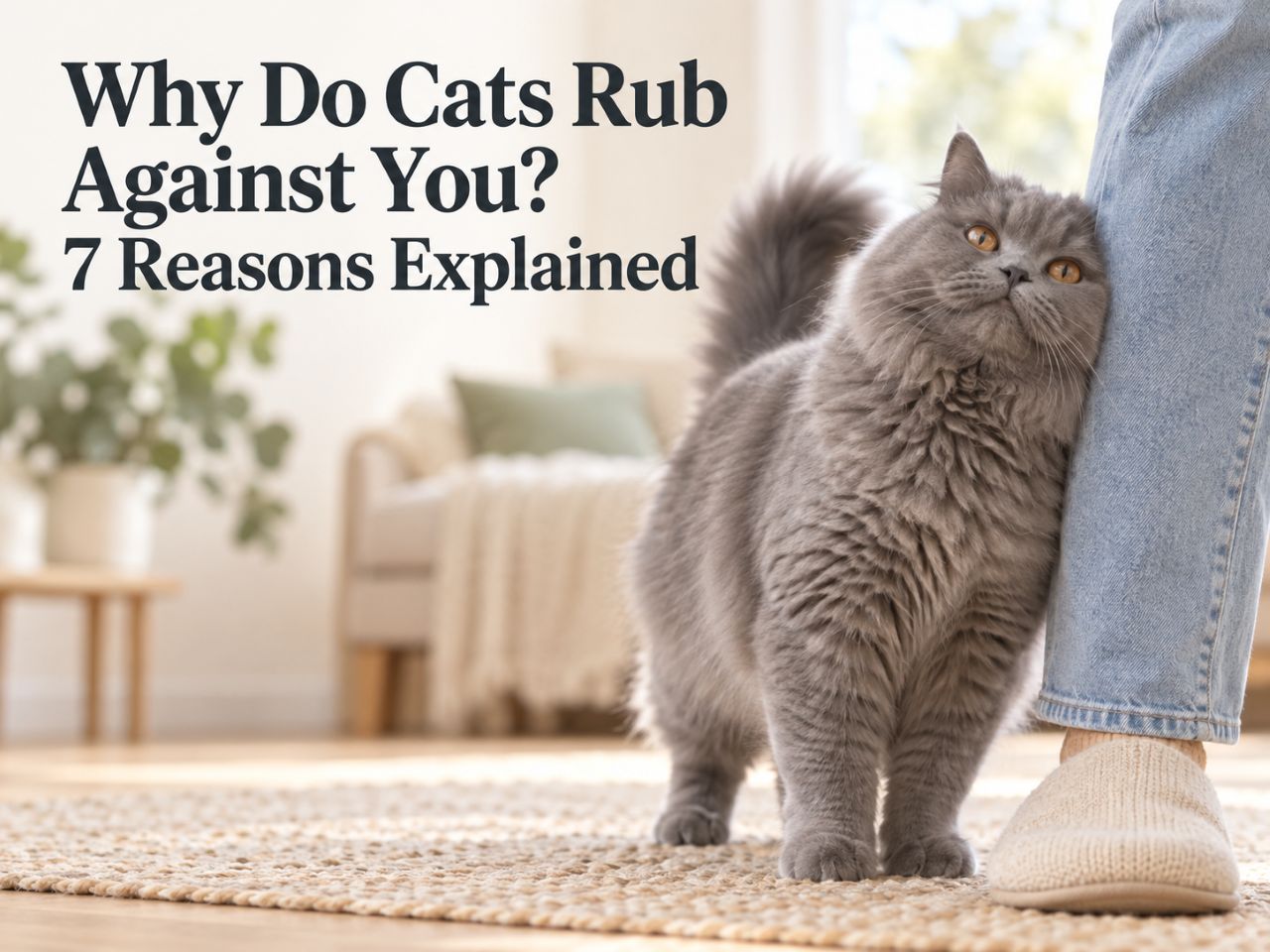
You walk through the door, and your cat immediately loops around your ankles. A cheek brushes your leg, the tail curls past your calf, and then the whole routine starts again. It can feel like affection, a demand for dinner, or a carefully planned attempt to trip you.
Most of the time, cats rub against you as a friendly greeting and a way to maintain a familiar social connection. The contact can also leave scent signals, get your attention, or lead you toward something they want. One rub may carry several of those meanings at once.
The rest of your cat’s body tells you which meaning fits. An upright tail, relaxed muscles, soft eyes, and an easy approach usually point to a comfortable social interaction. A low body, flattened ears, twitching tail, or quick retreat tells a different story.
What Is Cat Rubbing Called?
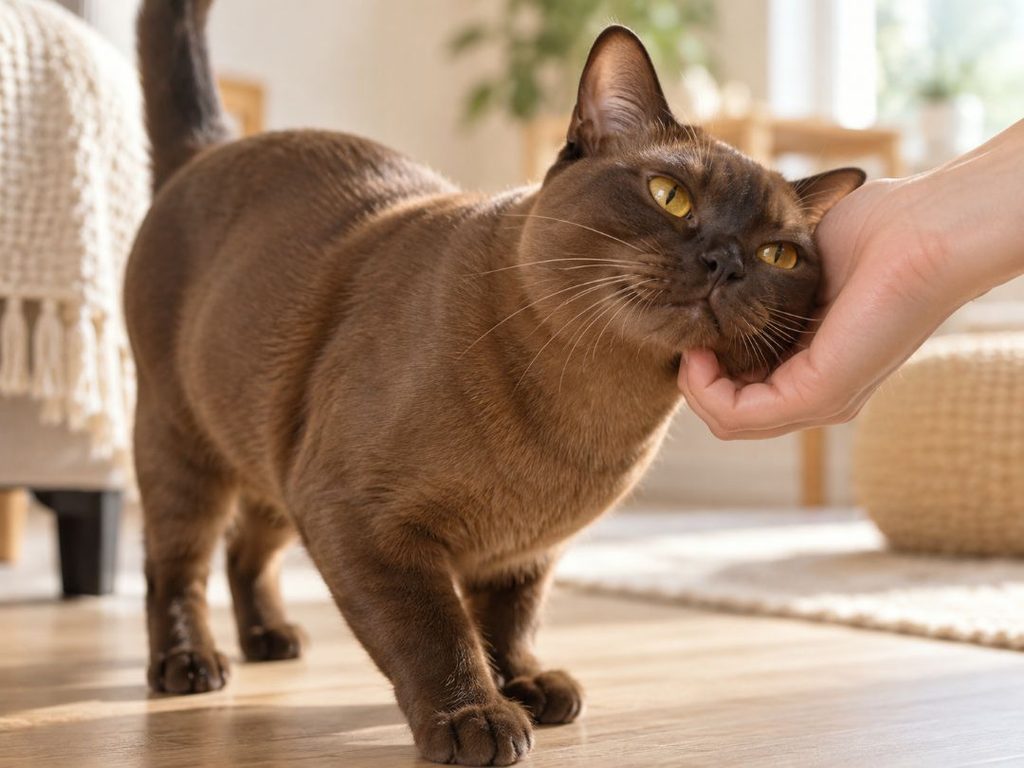
People often call any firm head nudge a “headbutt,” but cat bunting is the more useful term. Bunting usually involves the forehead, temple, cheek, or side of the face. A cat may press into your hand and then turn their head so your fingers slide across the cheek.
When a cat rubs their head or body against another individual, researchers call it allorubbing. Cats use this behavior with familiar cats, people, and sometimes other animals in their social group. Studies of free-ranging cats describe allorubbing as an affiliative behavior, meaning it is associated with friendly social relationships rather than conflict.
Cats also rub doorframes, couch corners, bags, and other objects. That version has a stronger scent-marking role, although comfort, habit, and curiosity can be involved too.
Why Do Cats Rub Against You?
There is no one-line translation for every rub. Look at what happened immediately before it, what your cat does next, and whether the behavior is typical for that individual.
Your Cat Is Saying Hello
Rubbing is a common feline greeting. You may see it when you wake up, enter a room, or return after being away. A friendly cat often approaches with the tail held upright, makes contact with the head or side of the body, and then stays nearby.
This greeting is not just something cats do for food. In a small home-based study, cats showed more purring and stretching at reunion after their owners had been away for four hours rather than 30 minutes. The researchers interpreted the change as increased contact-seeking after a longer separation.
That helps explain why your cat may give you a much bigger greeting after a workday than after you take out the trash.
Rubbing Helps Maintain a Social Bond
Cats that get along may approach with raised tails, touch noses, rub their heads or bodies together, and rest near one another. A pet cat can direct parts of that same social repertoire toward a trusted person.
So, why does your cat rub against you rather than simply sit nearby? Physical contact is one way to take part in the relationship. Your cat is choosing to close the distance and interact. When the body is loose and the approach is voluntary, that is usually a good sign of familiarity and trust.
It is fair to call this affection in everyday language. It is less accurate to treat every rub as a dramatic declaration of love. Cats also rub when they want information or have learned that the behavior produces a useful response.
Your Cat Is Leaving a Familiar Scent
Cats have scent-producing glands around areas of the face, including the cheeks, chin, mouth, and forehead. When your cat slides those areas across your hand or leg, tiny amounts of glandular secretion are transferred to you. Humans usually cannot detect the result, but scent is a major part of how cats organize their social and physical world.
You will often see these scent compounds described as feline facial pheromones. Researchers also use the broader word semiochemicals because the precise identity and message of every compound have not been fully demonstrated. The practical point is simpler: rubbing leaves chemical information behind.
Many articles say a cat is “claiming” their owner. That wording is catchy, but it makes the interaction sound more possessive than the evidence allows. Your cat is not filing a property deed. The rub may help make you smell familiar, renew a scent association, or mark your presence as part of a safe and known environment.
They Want Your Attention
Rubbing works. People look down, speak to the cat, offer a hand, scratch a cheek, or pick up a toy. Cats are quick to learn which actions get a response.
A cat who rubs your legs while you are at your desk may want social contact. One who rubs the treat cabinet, looks back at you, and meows has supplied more context. Your cat might be asking for food, play, access to another room, a clean litter box, or help reaching a favorite spot.
Watch what happens after the rub. A cat who walks toward a wand toy is giving you a different message from one who leads you to an empty water bowl.
They Are Investigating You
Cats sometimes rub people they barely know. That does not always mean the cat has formed an instant bond or wants to be picked up.
You may carry the scent of another animal, a restaurant, a garden, or a new laundry product. A cat can approach, sniff, rub briefly, and step away while gathering information. Let an unfamiliar cat control the distance. Reaching over the head or following the cat for more contact can turn a calm investigation into an uncomfortable encounter.
Something About You Smells Different
Some cats rub more after their person showers, changes clothes, comes home from another house, or handles another pet. The exact reason cannot be read from the rubbing alone. Your cat may be curious about the new odor, refreshing familiar scent signals, or using the moment as a reunion ritual.
There is no need to stop the behavior unless it creates a safety problem. If your cat winds tightly around your feet, pause rather than trying to step over them—especially near stairs or while carrying something hot.
An Unspayed Female May Be in Heat
An intact female cat may become unusually affectionate and rub persistently against people or furniture during estrus. Loud calling, frequent rolling, restlessness, raising the hindquarters, and moving the tail to one side make heat a more likely explanation.
Rubbing by itself does not identify estrus. If the pattern fits and you do not plan to breed your cat, talk with your veterinarian about spaying and how to keep her safely indoors in the meantime.
What Different Types of Cat Rubbing Can Mean
The location and timing of the contact offer useful clues, but none of these gestures has a rigid dictionary definition.
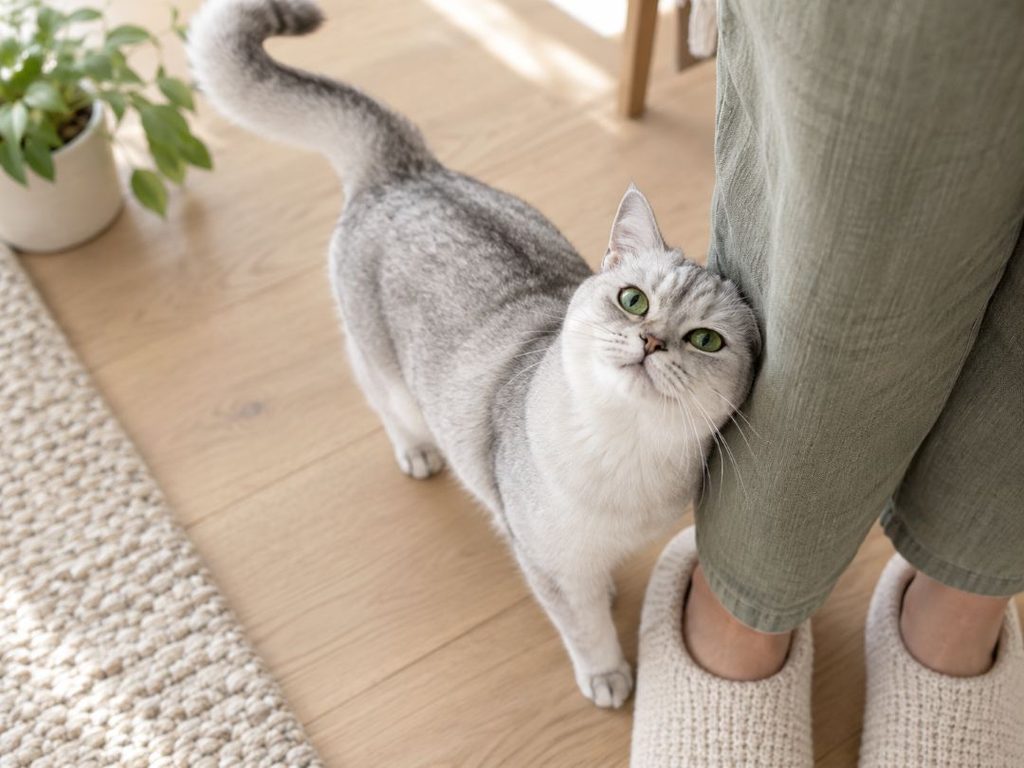
| What your cat does | Likely meaning in a relaxed cat | What to notice next |
|---|---|---|
| Presses the forehead into your hand | Greeting, bunting, or a request for brief contact | Does the cat lean back in after you pause? |
| Rubs a cheek along your fingers | Friendly contact and scent deposition | Soft eyes and relaxed whiskers support a positive reading |
| Slides the whole side of the body along your leg | Social greeting, attention-seeking, or scent exchange | Check whether the cat stays, leaves, or leads you somewhere |
| Wraps the tail around your calf | Close social contact during a greeting | An upright, softly curved tail usually goes with a friendly approach |
| Weaves repeatedly around your ankles | Excitement, attention, or a learned request | Meal timing and nearby resources may explain the urgency |
| Rubs a new bag or object | Investigation and environmental scent marking | Sniffing before and after the rub is common |
Does Rubbing Mean Your Cat Wants to Be Petted?
Sometimes. Not always.
A rub shows that the cat chose contact at that moment. It does not automatically grant permission for a full-body petting session. A greeting may be complete after one pass, and a cat inspecting your scent may not want your hand moving toward them at all.
Try a simple consent check:
- Hold a relaxed finger or hand near the cat’s nose level without moving it into their face.
- Let the cat close the remaining distance.
- If the cat bunts or leans in, give one or two short strokes around the cheek, temple, or chin.
- Pause. Continue only if the cat clearly reinitiates contact.
Research on cat-human handling found that interactions built around feline choice and attention to body language produced more affiliative behavior and fewer signs of conflict. The practical lesson is easy to use: let the cat have a vote.
Stop or pause if you see the skin ripple, tail begin to lash, ears rotate sideways or backward, pupils widen, or the cat sharply turn toward your hand. Walking away is also an answer.
Why Does My Cat Rub Against Me and Then Bite?
The rub and the bite can look contradictory, but the cat’s tolerance may have changed between those two moments.
Some cats enjoy only a few seconds of touch. They may initiate contact, become overstimulated, and nip when petting continues. Others intended the rub as a greeting rather than a request to be stroked. A playful or hungry cat may also grab at a moving ankle after weaving around it.
Do not punish the cat or keep petting to “teach” them to tolerate it. Freeze your hand, end the interaction calmly, and remember what happened just before the bite. Shorter petting sessions and regular interactive play often make the pattern easier to manage.
Pain deserves consideration if a normally tolerant cat suddenly bites when one exact area is touched. Skin irritation, an injury, arthritis, or another medical problem can lower a cat’s tolerance. A veterinary exam is appropriate when the reaction is new, intense, or tied to a specific body part.
Why Do Cats Rub Against Furniture and Doorways?
A home is full of scent landmarks that people never notice. Cats commonly rub prominent edges along their normal routes: a doorway, the corner of a couch, a table leg, or the edge of a cat tree. These surfaces are easy to press with the cheek and are encountered often.
Object rubbing helps deposit scent in the environment. It may contribute to a familiar “safe” scent landscape rather than serving as an aggressive warning to other cats. That is why a cat may rub a new chair, freshly delivered box, or recently cleaned corner more than an object that has been in place for months.
Normal facial rubbing does not damage furniture in the way scratching can, though pale walls may collect a faint oily mark over time. Clean the area gently and avoid strongly scented products around places your cat uses often. There is rarely a reason to discourage ordinary rubbing.
When Can Frequent Rubbing Signal a Problem?
The amount varies widely between cats. A highly social cat may rub dozens of times a day, while a healthy, well-bonded cat may show affection in quieter ways. A change from your cat’s normal pattern matters more than an arbitrary number.
Contact your veterinarian if rubbing suddenly becomes forceful, frantic, or nearly constant, especially when it appears with:
- intense scratching, overgrooming, bald patches, redness, scabs, or swollen skin;
- repeated ear scratching, head shaking, ear odor, discharge, or a head tilt;
- facial swelling, drooling, bad breath, pawing at the mouth, or trouble eating;
- pain when the face, neck, back, or another specific area is touched;
- confusion, loss of balance, circling, unusual vocalization, or other major behavior changes.
Parasites, allergies, skin disease, ear disease, dental pain, and neurologic problems are among the issues a veterinarian may need to rule out. Do not try to diagnose the cause from rubbing alone.
Head Bunting Is Not the Same as Head Pressing
A relaxed cat may bump you, rub the cheek along your hand, and move on. Head pressing looks different: the cat persistently pushes the top or front of the head against a wall, floor, or solid object without an ordinary social reason and may seem dull, disoriented, unsteady, or trapped in the position.
Head pressing can accompany serious neurologic or metabolic illness. Treat it as an urgent veterinary concern, particularly when it occurs with circling, poor coordination, vision changes, drooling, collapse, or seizures.
A Rub Is Part of a Conversation
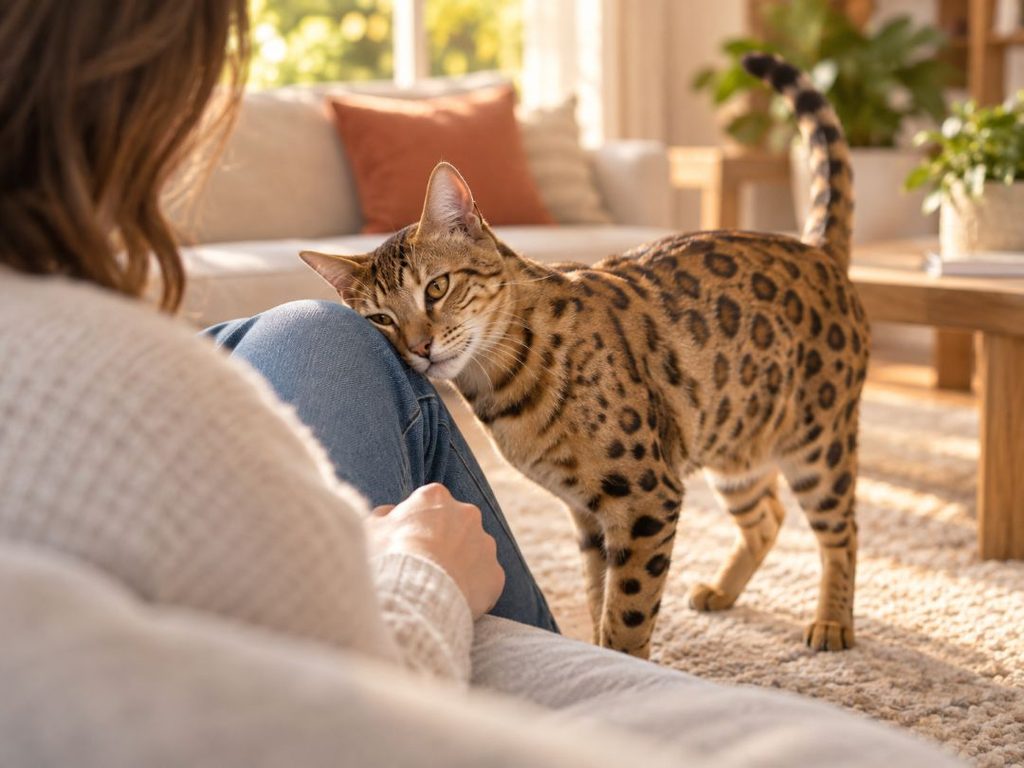
So, why do cats rub against you? Usually, your cat is greeting you, reinforcing a familiar relationship, sharing scent, or asking for something. The gesture feels affectionate because it often is—but its exact meaning comes from the setting and the signals around it.
Let your cat initiate, pause often when you pet them, and notice what follows the rub. Over time, you will learn whether that ankle weave means “hello,” “scratch my cheek,” “follow me,” or “dinner is late.”
At Catsoria, we believe ordinary moments like these become more meaningful when you learn to read the whole cat rather than relying on one gesture. A relaxed rub is not a mystery to solve so much as a small conversation worth answering.
This article is for general educational purposes and is not a substitute for veterinary diagnosis or treatment.
Frequently Asked Questions
1. Why does my cat rub against my legs?
Your legs are easy to reach, especially when you are standing or walking into a room. A relaxed leg rub is commonly a greeting, a way to leave scent, or an attempt to get your attention. If it happens beside the food bowl at the same time every morning, your cat may also have learned that rubbing helps breakfast arrive.
2. Why does my cat rub their face on my face?
Close facial contact usually reflects a high level of comfort because the cat voluntarily enters your personal space. The cat may be bunting, depositing facial scent, or asking for gentle cheek contact. Keep your face still and let the cat decide how long the exchange lasts.
3. Why does my cat purr and rub against me?
In a cat with a loose body, upright tail, and soft expression, rubbing plus purring usually goes with a friendly, comfortable interaction. Purring is not an infallible happiness signal, though. Cats may also purr when stressed or unwell, so read the whole body and situation.
4. Why does a cat rub against me and then walk away?
The greeting may already be complete. Your cat could also be leaving scent, checking in briefly, or trying to lead you somewhere. Walking away does not mean the rub was insincere, and it is better to respect the exit than to follow and insist on more contact.
5. Why does my cat rub against me after I shower?
Soap, shampoo, clean clothes, and the loss of familiar household odors can make you smell different. Your cat may be investigating that change or renewing a familiar scent association. If the behavior is calm and otherwise normal, it is not a cause for concern.
6. Do cats only rub against people they love?
No. Cats are more likely to allorub familiar social partners, but they may also rub during exploration or because the behavior has been rewarded with food or attention. Trust is best judged from a pattern of behavior: a relaxed approach, voluntary proximity, repeated friendly contact, play, and comfortable resting nearby.
Editorial Sources
- The Social Lives of Free-Ranging Cats — Animals
- Cats and Owners Interact More After a Longer Separation — PLOS ONE
- Best-Practice Handling During Human-Cat Interactions — Frontiers in Veterinary Science
- Dealing With Stress in Cats: The Olfactory Strategy — Frontiers in Veterinary Science
- Feline Skin Diseases — Cornell Feline Health Center
- Feline Ear Disorders — Cornell Feline Health Center
- Feline Dental Disease — Cornell Feline Health Center
- Disorders of the Liver and Gallbladder in Cats — Merck Veterinary Manual