

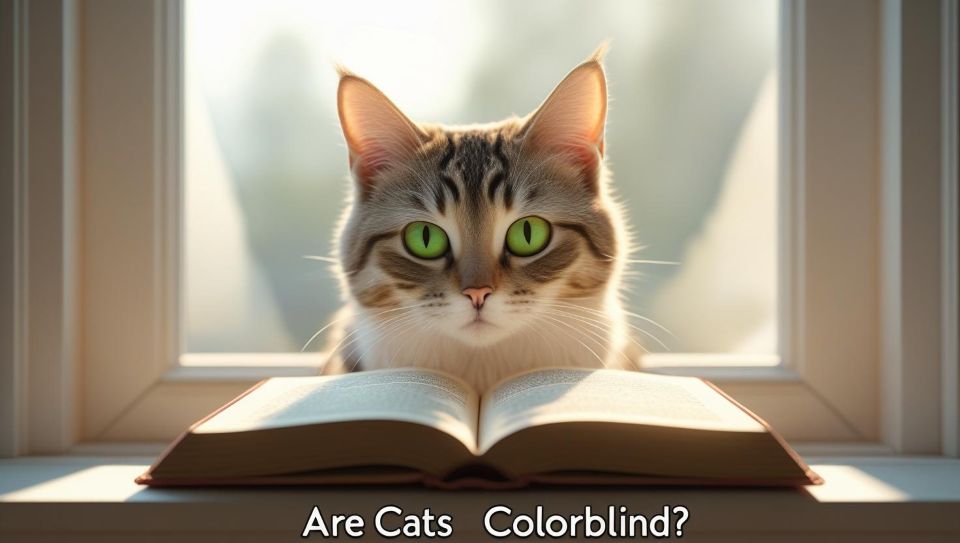
Have you ever waved a bright red toy in front of your cat, only to watch them ignore it and pounce on a plain gray sock instead?
Most cat owners have experienced something similar. It raises an interesting question: Can cats see colors, or are they completely colorblind?
For decades, people believed cats saw the world only in black and white. Modern research tells a different story. Cats can see colors, but not in the same way humans do. Their vision evolved for hunting, tracking movement, and surviving in low-light conditions rather than appreciating vibrant colors.
Understanding how cats see the world can help you choose better toys, create a more cat-friendly home, and gain a deeper appreciation for how your feline companion experiences everyday life.
Can Cats See Colors?
The short answer is yes.
Cats are not completely colorblind. They possess a form of color vision known as dichromatic vision, meaning they have two types of color-detecting cone cells in their retinas.
Humans have three cone types that allow us to distinguish millions of colors across the visible spectrum. Cats have fewer cone receptors, which limits the range of colors they can perceive.
While your cat doesn’t experience the vivid rainbow that humans see, their world is far from black and white.
Researchers believe cats can distinguish certain shades of:
- Blue
- Gray-blue
- Green
- Yellow-green
Colors containing strong red tones are much more difficult for them to identify.
What Colors Can Cats See Best?
Among all colors, blue and green appear to be the easiest for cats to detect.
A blue feather toy or a green ball may stand out more clearly than a red or orange toy placed beside it.
Scientists believe colors may appear muted to cats, almost as though someone lowered the color saturation on a photograph.
A rough comparison might look like this:
| Human Color | How Cats May Perceive It |
| Blue | Blue |
| Green | Greenish-gray |
| Yellow | Pale yellow |
| Red | Brownish-gray |
| Orange | Yellowish-gray |
| Pink | Gray or light beige |
| Purple | Blue-gray |
The exact experience remains impossible to measure because cats cannot describe what they see, but studies of retinal structure provide strong clues.
Are Cats Colorblind?
This question depends on how the word “colorblind” is used.
Cats are not colorblind in the traditional sense. They can detect certain colors and use color information when interacting with their environment.
A more accurate comparison is that cats see similarly to humans with red-green color blindness.
Many reds, oranges, and pinks appear less distinct and may blend into surrounding shades.
Their vision contains color, but the palette is much narrower than ours.
Why Cats Don’t Need Full Color Vision
From an evolutionary standpoint, vibrant color vision wasn’t necessary for feline survival.
Wild cats survived by:
- Detecting prey movement
- Hunting during dawn and dusk
- Identifying hidden animals in grass and shadows
- Navigating low-light environments
Color offered less survival value than motion detection.
As a result, nature invested in other visual strengths rather than expanding color perception.
Built to Hunt: Why Movement Matters More Than Color
A mouse darting through tall grass creates movement.
Movement triggers a hunting response.
Color does not.
Cats have a much higher concentration of rod cells in their retinas compared with humans. Rod cells specialize in detecting motion and brightness.
This allows cats to notice:
- Tiny movements
- Flickering shadows
- Fast-moving objects
- Activity in dim environments
That sudden twitch of a feather toy instantly grabs their attention because their eyes are designed to spot subtle motion.
How Well Can Cats See at Night?
One of the most remarkable features of feline vision is its low-light performance.
Cats cannot see in complete darkness, but they need far less light than humans to navigate effectively.
Several adaptations help:
- Large Pupils: Cat pupils expand dramatically in dim environments, allowing more light to enter the eye.
- Reflective Eye Layer: Cats possess a specialized structure called the tapetum lucidum. This reflective layer acts like a mirror behind the retina, bouncing light back through the eye for a second chance at detection. It’s also responsible for the glowing effect you see when light reflects from a cat’s eyes at night.
- High Rod Cell Density: More rod cells mean better sensitivity to low light and motion.
Together, these features make cats exceptional twilight hunters.
How Sharp Is a Cat’s Vision?
Cats see differently from humans in several ways.
Human visual acuity is significantly sharper.
A person can often identify details from 100 to 200 feet away.
A cat typically needs to be much closer to see the same level of detail.
Veterinary researchers estimate feline vision is approximately 20/100 to 20/200 compared with average human eyesight.
That means objects appearing crystal clear to you may look slightly blurry to your cat.
Do Cats Have Better Peripheral Vision Than Humans?
Yes.
Cats enjoy a visual field of roughly 200 degrees, compared to approximately 180 degrees in humans.
This wider field helps them monitor potential threats and prey without moving their heads.
Their peripheral vision is especially effective at detecting movement.
This explains why your cat can instantly react to a toy moving across the edge of the room even when appearing relaxed.
How Cats Use Contrast Instead of Color
Color is only one piece of visual information.
Contrast often matters more.
A black object against a white floor is easier for a cat to identify than two similarly colored objects blending together.
Cats frequently rely on:
- Light versus dark contrast
- Motion
- Shape
- Texture
- Sound
This explains why a plain cardboard box can outperform an expensive brightly colored toy.
The box offers:
- Interesting textures
- Hiding opportunities
- Strong visual edges
- New scents
To a cat, that’s far more exciting than color alone.
Can Cats Recognize Their Owners by Sight?
Many people assume cats recognize humans primarily through vision.
In reality, sight is only one part of the puzzle.
Cats rely heavily on:
- Scent
- Voice
- Body movement
- Routine patterns
Your cat likely recognizes your walk, your scent, and your daily habits long before focusing on facial details.
Vision supports recognition, but smell remains their strongest identification tool.
What Colors Are Best for Cat Toys?
When shopping for toys, color should not be the primary consideration.
Features cats respond to most include:
- Unpredictable movement
- Feather textures
- Crinkling sounds
- Interactive play
- Chase opportunities
That said, toys in blue and green shades may be easier for cats to distinguish visually.
Choosing toys with strong contrast against your flooring can also help keep them visible during play.
How Does Aging Affect a Cat’s Vision?
Senior cats often experience gradual changes in eyesight.
Common age-related vision changes include:
- Reduced night vision
- Increased cloudiness of the lens
- Lower contrast sensitivity
- Slower visual processing
Regular veterinary exams become increasingly important as cats age.
Early detection of cataracts, retinal disease, glaucoma, or hypertension-related eye problems can help preserve quality of life.
Signs Your Cat May Have Vision Problems
Contact your veterinarian if you notice:
- Frequently bumping into furniture
- Hesitation when jumping
- Enlarged pupils
- Excessive squinting
- Cloudy eyes
- Increased startle responses
- Difficulty finding toys or food bowls
Vision changes can occur gradually and may indicate underlying medical conditions.
Final Thoughts
Cats experience a world that looks very different from ours. They can see colors, but their color palette is limited. Blues, greens, movement, contrast, and light levels play a much larger role in how they interpret their surroundings than bright reds or vivid pinks. Their eyes evolved for hunting, not for admiring colorful landscapes. Every aspect of feline vision prioritizes survival: detecting motion, navigating dim environments, and spotting opportunities that humans might miss. The next time your cat ignores a brightly colored toy and chases a shadow across the floor, remember that they’re seeing the world exactly the way nature designed them to.
Frequently Asked Questions
1. Can cats see red?
Cats can detect some wavelengths associated with red, but they do not perceive red the same way humans do. Red often appears as a muted grayish or brownish shade.
2. Can cats see blue?
Yes. Blue is one of the colors cats appear to see most clearly.
3. Can cats see green?
Research suggests cats can distinguish many green shades, although they may appear less vibrant than they do to humans.
4. Are cats completely colorblind?
No. Cats have dichromatic color vision and can perceive certain colors.
5. Can cats see in total darkness?
No. Cats need some available light to see. Their vision is highly adapted to low-light conditions but not complete darkness.
